
How Public Procurement Locks Out Britain’s Small Manufacturers
by Meg Pirie
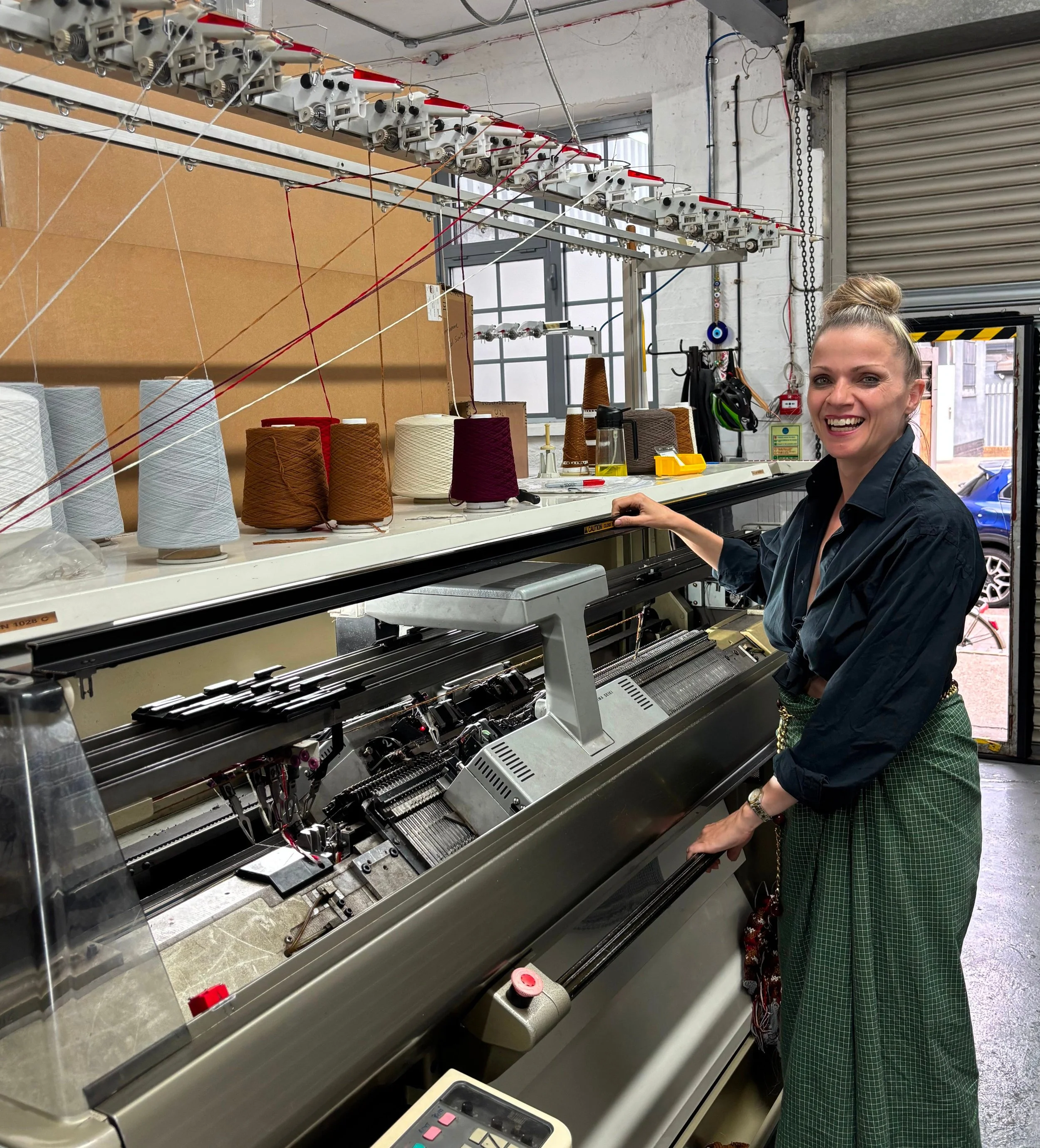
Emma McClelland, co-founder of Knitster. Credit: Knitster.
It’s a bright, sunny morning and Emma McClelland, one of the co-founders of Knitster, a luxury knitwear manufacturer in the heart of London, greets me with an equally luminous disposition. Knitster started as a swatch studio back in 2017, but post-Brexit, and like many SMEs, the business made a concerted pivot in its model taking control of its own production through the purchasing of knitting machines and developing a team, which now sits at around 14 staff. Although small, the team services the sort of clients that grace fashion weeks across the world, Emma mentions Christian Dior, Bottega Veneta, including J W Anderson and Herd closer to home, as well as a nod to another British luxury fashion house that she can’t mention due to confidentiality reasons.
As many manufacturers will later come to tell me, investing in machinery and staff is a leap of faith in the current climate, and one that Emma despite her sunny demeanour has done with grit and determination to make her luxury knitwear manufacturing business work. Emma explains:
“We got our first Shima in 2022 which was really challenging. We went from a very healthy profit to a really chunky loss. And actually, it’s only last year that we’ve made profit again, because we’ve invested so heavily.”
When things weren’t going well for the business, Knitster were contacted by Innovate UK, the UK’s innovation agency, to apply for a procurement contract making knitted garments. Like other SMEs, winning a contract of this size would have been a game-changer for the business, as secure and consistent orders are one of the most effective ways to keep manufacturing businesses and the factories within their networks operating in the UK. Emma tells me:
“When we were asked to apply, we thought, maybe this is going to be our golden ticket, but it was a nightmare.”
They were encouraged to pay for varying ISO certifications (standard certifications) under the premise that they would get extra points if these were in place for quality and environmental management, as well as cyber security. Each of these certifications came in at around £5-6,000 each – no small fee for a small business. On top of this they were drowned in paperwork with a lack of support:
“It was weeks of paperwork. It was unbelievable. Gantt charts and Excel sheets and all the costings for every single garment – how much they would cost in one to two years, the whole lot. For the first contract I think just not really understanding or having the proper support, even though we were led into this and the amount of money that it cost was problematic.”
The other issue was the nebulous nature of the specifications. This ambiguity meant they couldn’t buy an off-the-shelf yarn, which meant sourcing a contract spinner in Transylvania just to get the yarn made. Every time they raised a question, the message board – their only channel for communication on the tender – referred them straight back to the specifications, leaving them caught in an automated loop with no resolution. This was not the case when they were approached recently to make uniforms for a French supplier, who specified exactly which yarn to use, ready to order off-the-shelf.
At one point, Emma says they had felt like giving up, but the costs they had incurred to that point meant they had no choice but to keep going. At the time Emma recalls thinking, “We’re in so deep, we might as well just keep going.”
In the end, their tender didn’t qualify, partly because their contingency planning didn’t score highly enough, going instead to a key player in the procurement space: a UK registered company that manufactures overseas, a loophole that many SMEs have flagged. The fact that they were making the entire garment in the UK didn’t increase their chances, nor did the fact that they were a female-led business. This despite being told it would and in the end Emma says this boiled down to cost.
“We’re in so deep, we might as well just keep going.”
Undeterred, Knitster tried again for a public procurement contract, this time for socks, following an encouraging feedback call with the procurement body. With feedback under their belt, Emma assumed this would be easier, having made all necessary changes to their application. However, they came up against a stumbling block almost instantaneously, having been asked for an antimicrobial finish on the sock, without any indication of a recipe. However, the real issue came when it became apparent that the specification, the sample, and the scoring matrix used to judge it didn't match each other. Emma explains:
“You get a marking matrix, you get a specification and you get a sample to copy. What they were asking for in the specification did not align with the marking matrix and it did not align with the sock. So the sock came out of production and every time we got told to go back to the spec. Whoever had made that sock and it had gone into production had not gone back to the spec, they had gone to the marking matrices instead.”
In practice there was no way of going back to the specification and passing it. Emma tells me there were things that just didn’t match up like the yarn count and the number of needles on the machine – basic specifications which manufacturers require, but which those writing the procurement bids might not necessarily know about, highlighting a policy gap between government departments in terms of textiles – something that our latest report raises. In the end the common denominator that was missing from both contracts was a textile expert at the end of the phone.
The costs also kept on coming. The socks had to be sent for testing, an additional cost. The socks had to be sent as a representation of bulk. To Emma, this felt geared toward big businesses who’d done it before; making these in bulk simply wasn’t achievable for a small business. Businesses must also bid for the entirety of styles, and cannot cater to just one or two styles. In practice this meant three styles needing to be made in bulk and tested – an additional cost.
The knock-on effects go beyond Knitster. During the tender process, she recalls speaking to Peter Benson, at one time MD of Benson & Garratt Ltd. He explained that when the Ministry of Defence pulled its contracts from UK suppliers, sock manufacturers went under and the skills to make them were lost. As a result, there are currently no UK sock manufacturers with the capacity or certifications to supply the Ministry of Defence. Sourcing and design could stay in the UK, but the production, she tells me, would have to be outsourced to Europe.
Emma’s experience speaks to something bigger. Symptomatic of Britain’s race to chase the lowest price is the loss of manufacturing and the skills that go with it. The point being that if we keep outsourcing our garments, we will continue to lose the skills and manufacturers needed to make them. Isn’t it therefore easier to invest in SME manufacturers now than to rebuild later, I ask.
That is just what Emma at Knitster is doing, knowing that her team is highly skilled, she is actively looking at training apprentices. One of these skilled jobs in the factory is writing the knitting patterns; another is linking, currently done by a colleague in her 50s. Both are skills Emma is committed to keeping alive in the business through continued investment.
In the end, one of the issues about procurement is that it goes to the lowest compliant bidder. Emma adds:
“I don’t think that makes any sense to me because it discourages people and companies from making it in the UK. What happened to investing here? I don’t get it. I think for the greater good we should be made here. Invested in skills right from the farm, you know?”
Emma’s story is not an isolated one. This is a pattern behind our latest research into the current barriers of procurement in the UK. Our open letter, which now has over 1,000 signatures, calls on the Government to commit to onshoring British defence and NHS uniforms, and establishing a dedicated textiles task force to unify fragmented policy across government departments.