
If a former First Lady is sharing her ideas in "The Look" has the era of the celebrity stylist reached a new level?
Just over a decade ago now, I entered the Houses of Parliament for the first time and was not only shocked by the canary yellow choice of paint for the walls of the Opposition’s Shadow Cabinet room, where as a mentee of the Fabian Women’s Network scheme I met not only my other mentees, but also the Chief Whip and numerous MPs; I was also confused by the sartorial choices so many women in politics make. Imposter syndrome I know I have, but communicating a narrative through the medium of clothes, reader, this is my comfort zone.
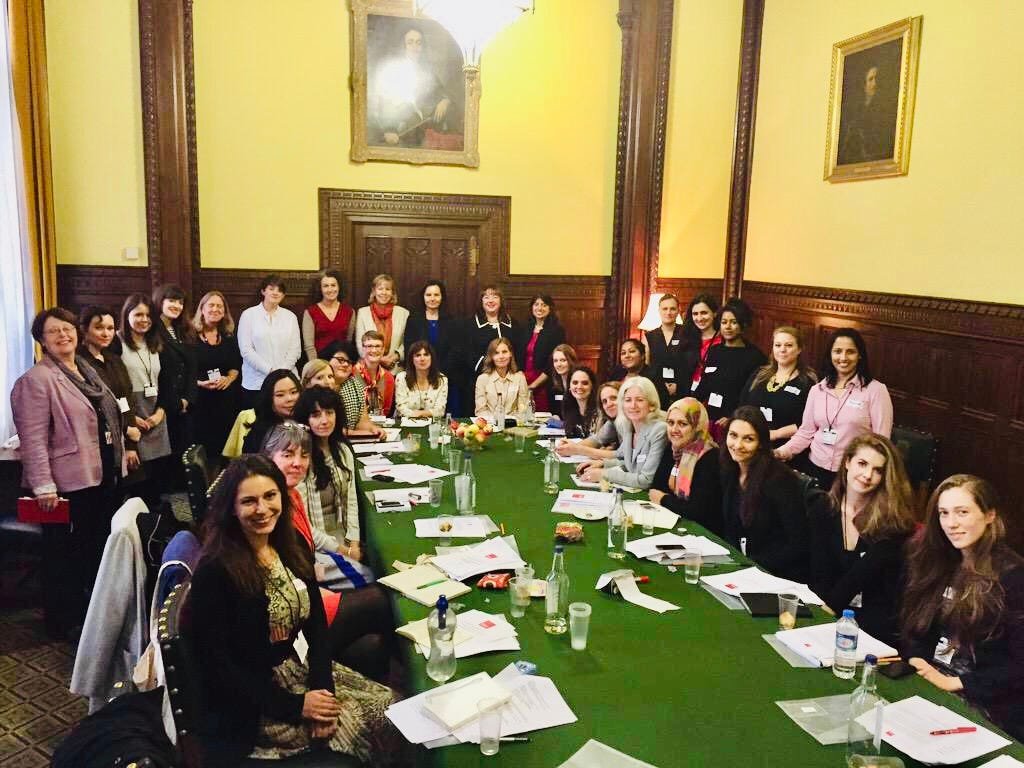
Tamara and her fellow Fabian Women’s Network mentees in the Shadow Cabinet office in the House of Commons.
My mentor, Sharon Hodgson MP offered me a role in her Westminster office after I completed the mentoring scheme, and this is how I saw the sartorial choices of so many women up close in parliament, which quite frankly I did not understand. This does not include Sharon, who as a proud Northern woman is always immaculate and would tell me about her purchases from eBay of her favourite brands. Westminster is famously called a village and it is literally as large as one. What visitors don’t realise is there are tunnels connecting the older palace to the more modern buildings. You can enter half way along Downing Street, or the secret Tube entrance, and if you are a parliamentary passholder never leave the parliamentary estate until the far end of the House of Lords, over a third of a mile away. Inside the estate, you have everything from restaurants, to childcare, hairdresser, to post office, library, to pub. As someone once told me, “when you’re in, you’re in.” I literally felt that every day, as the food shopping outside - a tiny Tesco Metro next to the Tube station filled with tourists - was not draw enough away from the buzz of all the political chatter.
What was not inspiring however, was seeing women vacuum packed into body con dresses and heels, trying to keep step with men in suits and obviously flat lace up shoes. If you are averaging 20,000 steps just to get around your place of work: up Gothic staircases, dashing to briefings in freezing Victorian rooms, or navigating the Division Bell deluge to get to the vote - a 4 minute dash when MPs have to (quite literally) rush to vote - often racing from one end of the estate to the House of Commons voting lobby. Much as I love a heel, this is not their moment.
Women I met working in parliament had paid Colour me Beautiful experts who told them to wear the colour of their political party. This made a degree of sense, as in ok show your tribe. But, as I pointed out if you are a Labour women trying to gain votes from other parties, is shining like a Belisha beacon or children’s TV presenter, the way to win their trust? If you are seeking votes in the Cotswolds/Shires/city, perhaps blend in? Or be yourself? I am really not convinced by the colour by numbers approach, especially when combined with body con dress discomfort and sore feet. If it was me, I would lean in on being me, or even do a Carolyn Harris, the MP for Neath and Swansea East. She of the purple hair and menopause campaigning, who is 100% authentically herself. I fall into the wear whatever makes you happy camp, rather than wear Autumn shades/dress like a presenter for ITV’s Rainbow (remember that?).
Listen to our Carolyn Harris podcast
For this podcast, Tamara Cincik from Fashion Roundtable speaks to Carolyn Harris MP about her working class background, what it means to be a working class Welsh woman in the Houses of Parliament, her vital work as the leading voice lobbying the government on the issues facing women and the menopause.
Carolyn’s work on this issue cannot be underestimated and her insights on the impacts for generations of women who have been misdiagnosed or ignored, are powerful.
She also speaks about her path to a leadership role, while remaining grounded and the other campaigns, including food poverty and gambling, that Carolyn is also working hard on.
For key insights into effective politics with common sense and authenticity at its core, this is an important conversation.
This was the dawn of Alexandria_Ocasio-Cortez (AOC) whose story was so moving, that when I watched the Netflix documentary ‘Knock Down The House’ about her path to victory, I cried. She wore out shoes campaigning in her district and wore her signature red lipstick and golden hoop earrings with pride. At this stage, my Fabian fellow mentees were entering elected office here in the UK. I was regularly advising them in Whatsapp messages to ditch the TV presenter bright red jackets for something more individual, which communicated who they are, and also suggesting they wear white suits or jackets. To date, these women are now several MPs, two Peers, double digit councillors, multiple CEOs and charity leaders.
In the U.S. white is the colour of female suffrage, so when AOC wore an all-white suit as the youngest woman ever to be elected at her swearing-in ceremony during the 116th Congress, she was doing this consciously: “I wore all-white today to honor the women who paved the path before me, and for all the women yet to come. From suffragettes to Shirley Chisholm, I wouldn’t be here if it wasn’t for the mothers of the movement.” AOC was responding to a tweet from Amanda Litman, the co-founder of Run For Something: “Early suffragists wore all white. Shirley Chisholm wore all white to be sworn in. Geraldine Ferraro wore all white when she accepted the VP nomination. Hillary Clinton wore all white to accept the Democratic nomination in 2016. And today, @AOC is wearing all white. History!!” She was joined by Rep. Ilhan Omar and Rep. Madeleine Dean, who also decided to wear all-white to the ceremony.
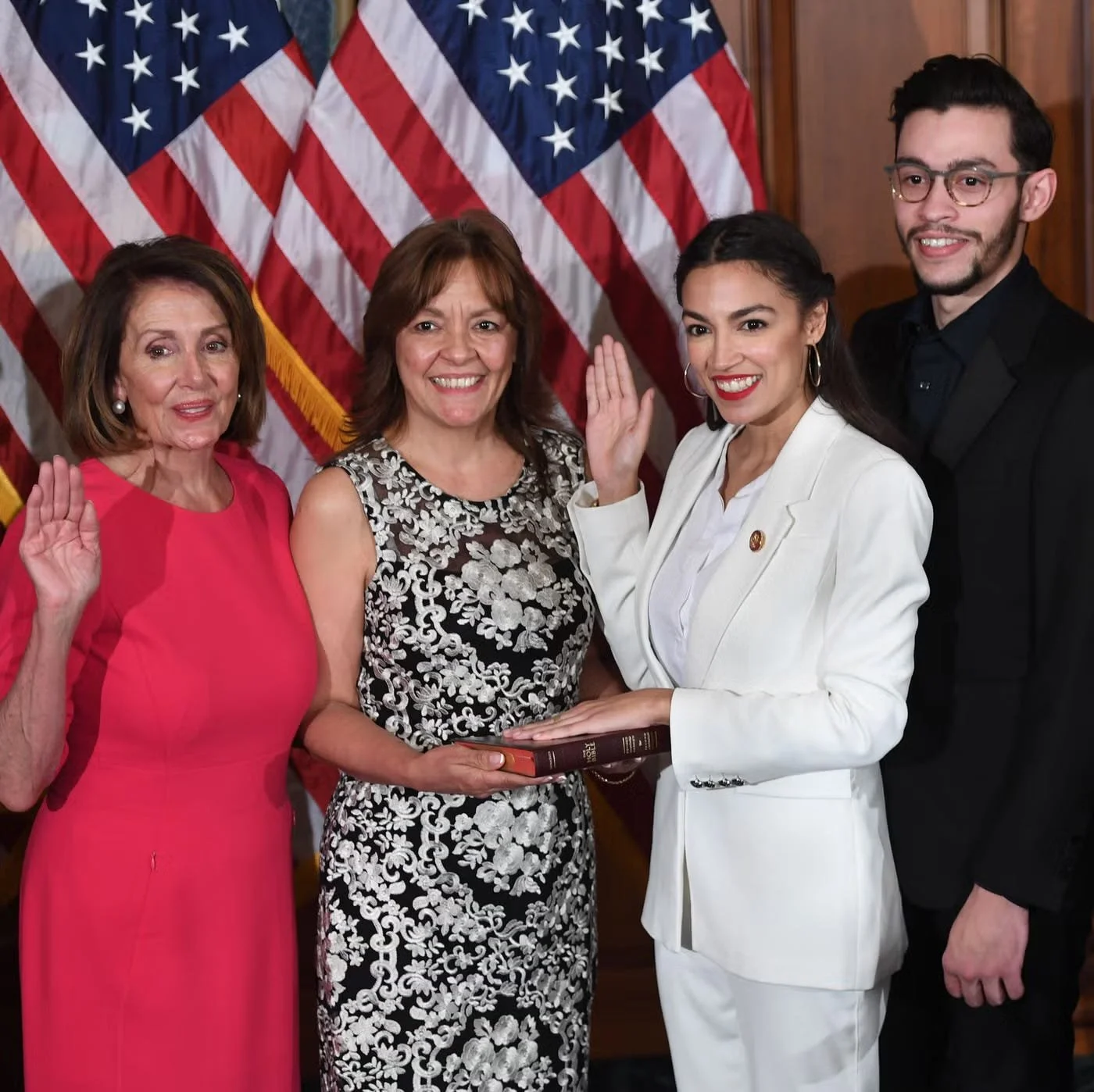
Photo: SAUL LOEB//Getty Images
The wear white memo has featured heavily at recent US State of the Union addresses largely by the Democratic Women’s Caucus (DWC) since Trump’s first term and through Biden’s. For the March 2025 address white was combined with pink.
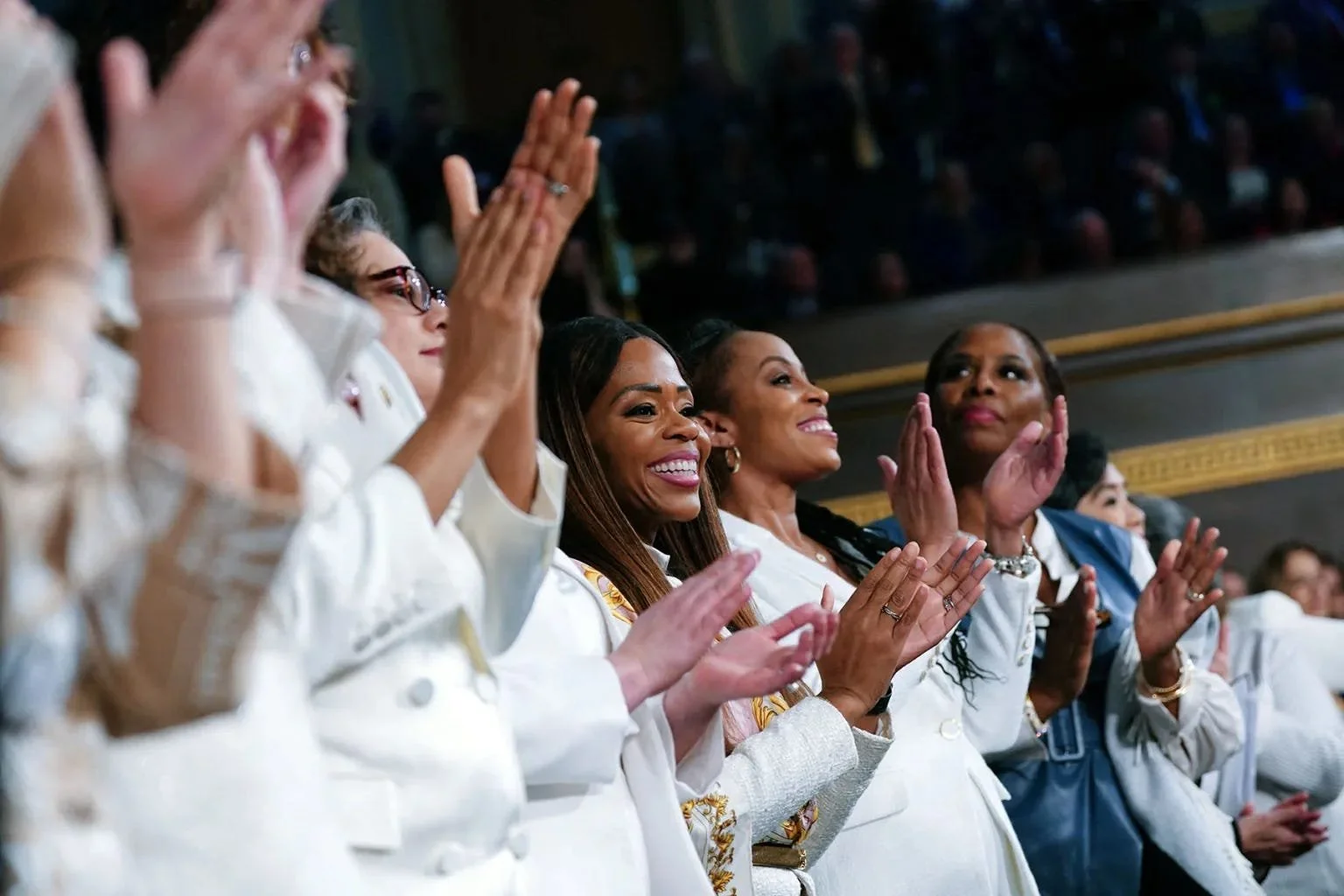
Democratic Representatives cheer as President Biden delivers his State of the Union address on March 7, 2024. (SHAWN THEW–POOL/AFP/Getty Images)
Why? New Mexico Rep. Teresa Leger Fernández, who chairs the Democratic Women’s Caucus, told Time magazine that wearing pink is meant to call attention to Trump’s administration “negatively impacting women and families. Women are claiming pink as a color of protest, as a color of power, and we are protesting what is happening right now.”
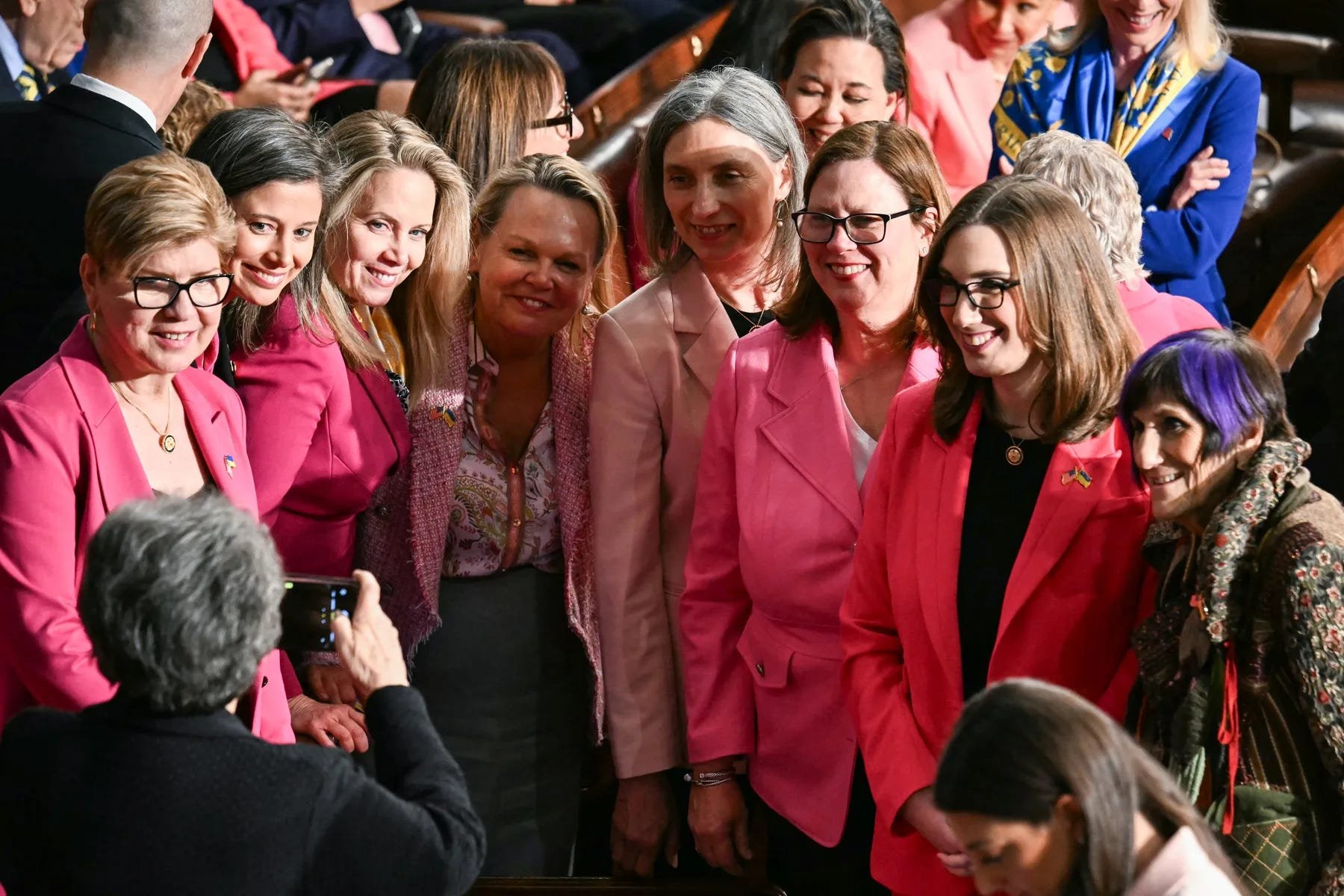
Women Democratic members of Congress wearing pink to protest the Trump administration's policies pose for a photo ahead of US President Donald Trump's address to a joint session of Congress in the House Chamber of the US Capitol in Washington, DC, on March 4, 2025. (Jim Watson/AFP/Getty Images)
Former First Lady Michelle Obama has taken the wear what makes you happy memo to the next level. So much so, that with the help of her stylist (never underestimate the power of a good stylist) Meredith Koop she recently published “The Look” - a New York Times No 1 bestseller no less - which charts her life through her relationship with clothes in her public and private lives. “I learned to harness my look as a way to reflect my values, lift up underrepresented voices, and share my personal story. I’ve seen how critical it is for each of us to feel good about ourselves and be confident in who we are—because when we do, we show off the full spectrum of backgrounds and experiences that has always been the strength of our country.”
She writes how the impact of serving as First Lady during the height of a US recession and why this helped her to make different sartorial choices. While whippet-thin former actress Nancy Reagan was known for her love of haute couture and Jackie Kennedy favoured Chanel or Oleg Cassini, Obama became known for her “high-low” approach. Alongside designer labels she wore high street fashion labels including H&M, Target and J Crew. “As First Lady, you’re put on a de facto pedestal because the role has historically carried so much ceremonial significance, representing the notion of womanhood itself, of femininity and the spousal ideal,” she writes. “I knew that I had to define my own fashion philosophy, and I was not interested in a “look, don’t touch” approach. If anything, I wanted to invite people in: for an embrace, or a meaningful conversation, and even into the White House, which, from the day we moved in, I wanted to be as open and welcoming as possible (and as security would allow). My clothing had to reflect that.”
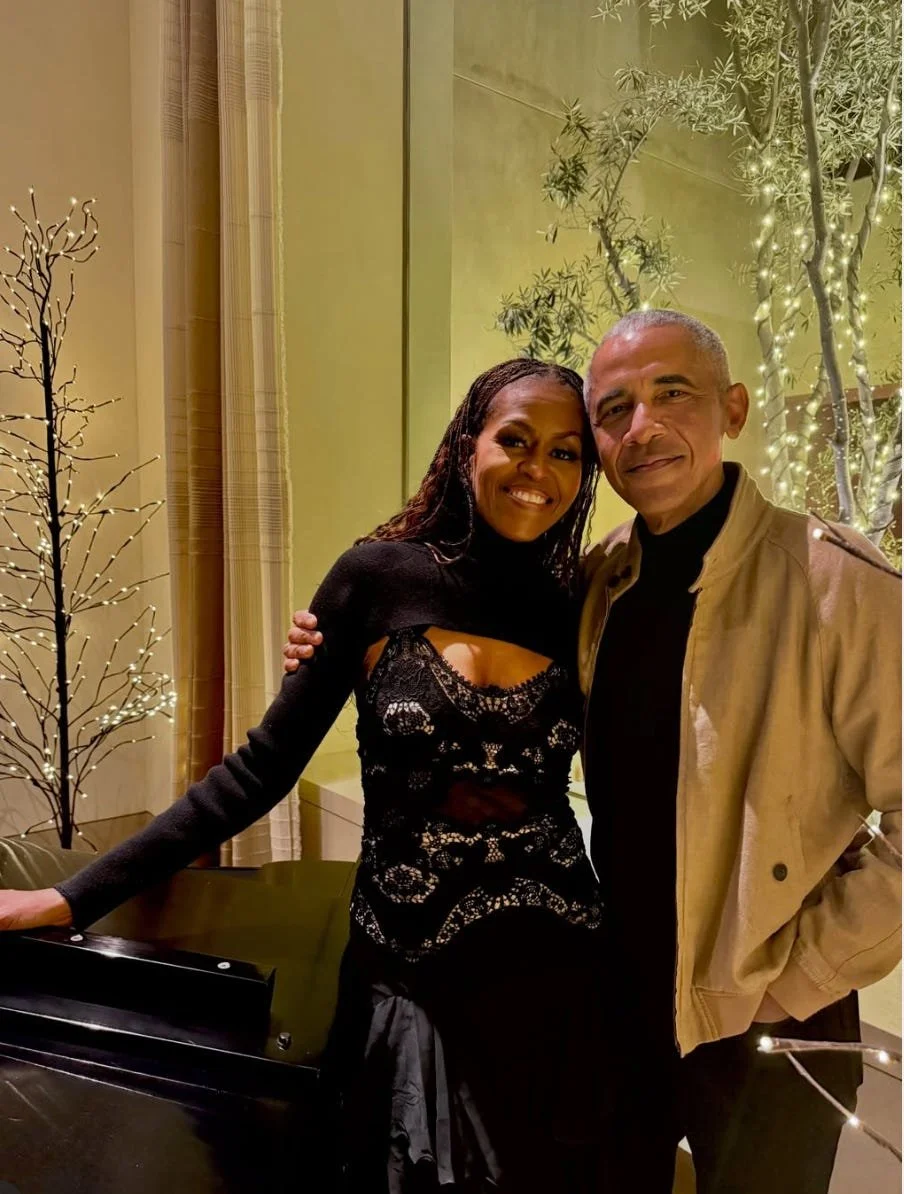
Michelle and Barack Obama this Christmas, Michelle Obama’s Instagram
Smart. And authentic. I personally adore her post White House fashion renaissance, the freedom of seeing a 65 year old woman who is confident, celebratory and joyous is a delight to watch, away from the scrutiny of “sleevegate” nonsense about her First Lady predilection for a sleeveless dress. Like, who cares?
Compare this to Melania Trump, who clearly LOVES fashion, and I sense a case of over moodboarding. The Out of Africa pastiche collection for her solo visit to Malawi, Ghana, Kenya and Egypt during their first term was frankly tone deaf. It looked and felt colonial and even a pretty woman, which Melania Trump clearly is, cannot really carry off a pith helmet, nor should they.
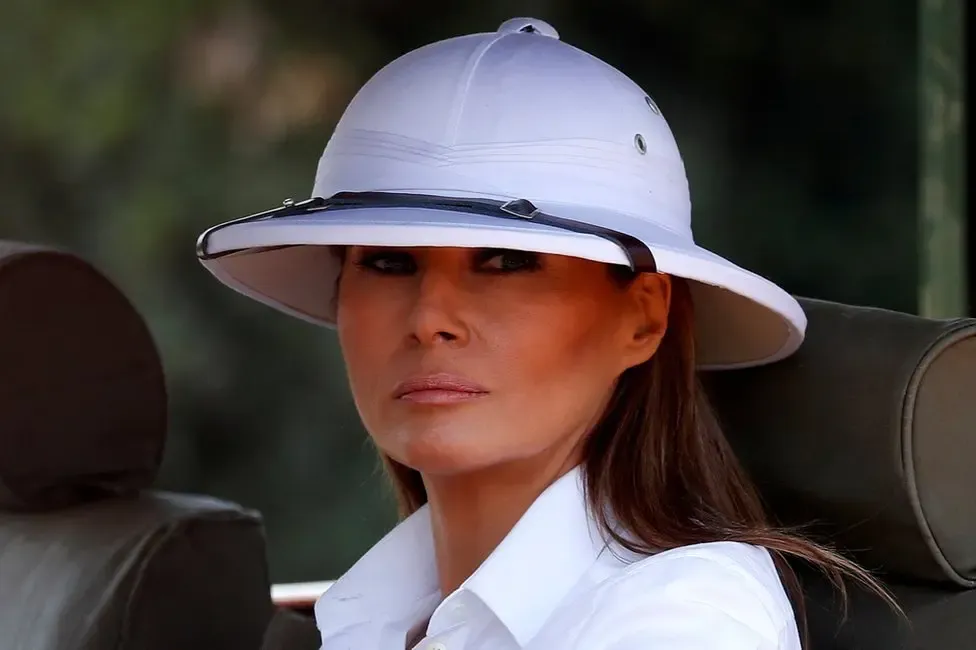
REUTERS
A solo visit is not a Carry On film, though The English Patient was clearly on Herve Pierre’s moodboard.
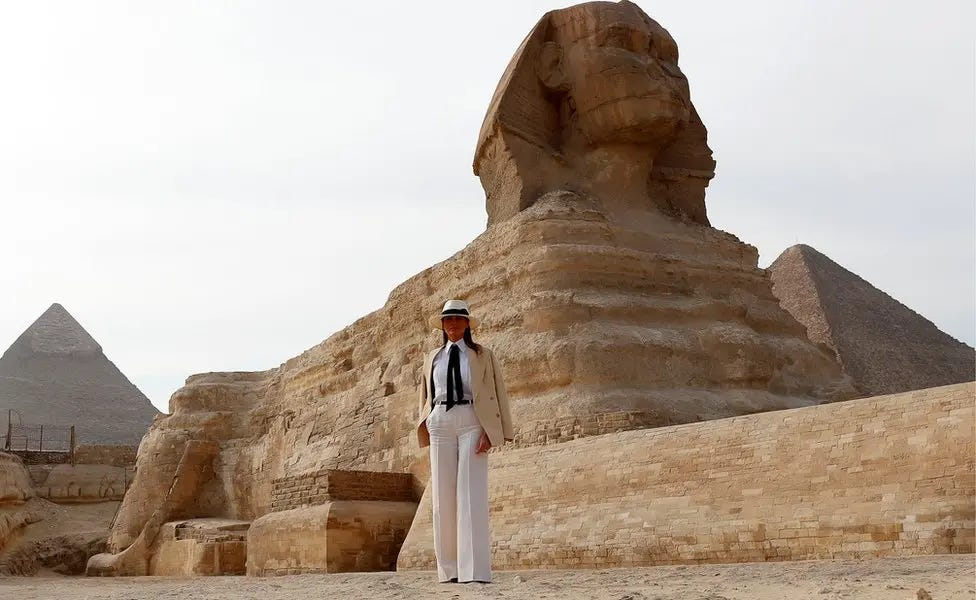

Melania Trump at the Pyramids; The English Patient
Herve Pierre worked as a designer for several houses including Balmain and Oscar de la Renta and what’s interesting is his comments to The New York Times where he points out that politics aside, dressing someone for state visits, or to meet the Pope, is so unusual as to make the role extraordinary. And I don’t disagree, but perhaps where a stylist would differ from a designer in this role is a stylist - a good one anyway - would consider the person, not the image, first.
Which is why perhaps Dame Anna Wintour has not invited the Trumps to the Met Gala, or Melania back onto a Vogue cover (apart from her wedding in 2005), unlike other First Ladies. As well of course for Wintour’s well documented allegiance to the Democrats. However, while Wintour knows well the power of a magazine cover (digital or tearsheet) to communicate, and of clothes to tell a story, her interest in the Trumps has been to discuss the impact of tariffs. As if fashion is anything, it is business. Big business. And viral stories about white suits, or high-low dressing always underline this. Wintour told Variety magazine:
Speaking of tremendous change, many people noted your recent visit to the White House to talk about tarrifs. What was the result of that meeting?
I’ve been twice. The President, the Vice President and the chief of staff were amazingly open to everything that we were talking about. The fashion industry itself is already highly tariffed at 12.5%, so anything on top of that would be stacking. We’re seeking clarity, and looking at a reality where small business – the tariffs can amount to as much as their payroll. The President talks so much about how important America creativity and American traditions are, particularly as we look towards the 250th anniversary of [the country]. How can we support the creativity and designers who want to make things in America? With tariffs so high, it’s going to become more and more challenging to do so.
The President is no stranger to the art of the deal, did he try to barter a Vogue cover for anyone in his family?
That didn’t come up.
If you want a good podcast to listen to which explains why we need to see fashion as business, listen to the recent Leading podcast with Anna Wintour interviewed by Rory Stewart and Alistair Campbell. I shared it before the holidays too, as it really is a fascinating conversation with a 76 year old woman, still at the top of her game, who understands why fashion matters, culture is key and business is business. And this goes far beyond who wore what when. I wish more leaders would take note.