
FOR IMMEDIATE RELEASE
24th April, 2026
Fashion Roundtable Launches Landmark Report on Policy Fragmentation and
Place-Based Opportunity in UK Fashion and Textiles
Fashion Roundtable has published a major new report, Policy Fragmentation and Place-Based Opportunity in UK Fashion and Textiles, authored by Tamara Cincik and Alix Coombs, in partnership with the Local Policy Innovation Partnership (LPIP) Hub led by the University of Birmingham’s City Region Economic and Development Unit (City-REDI).
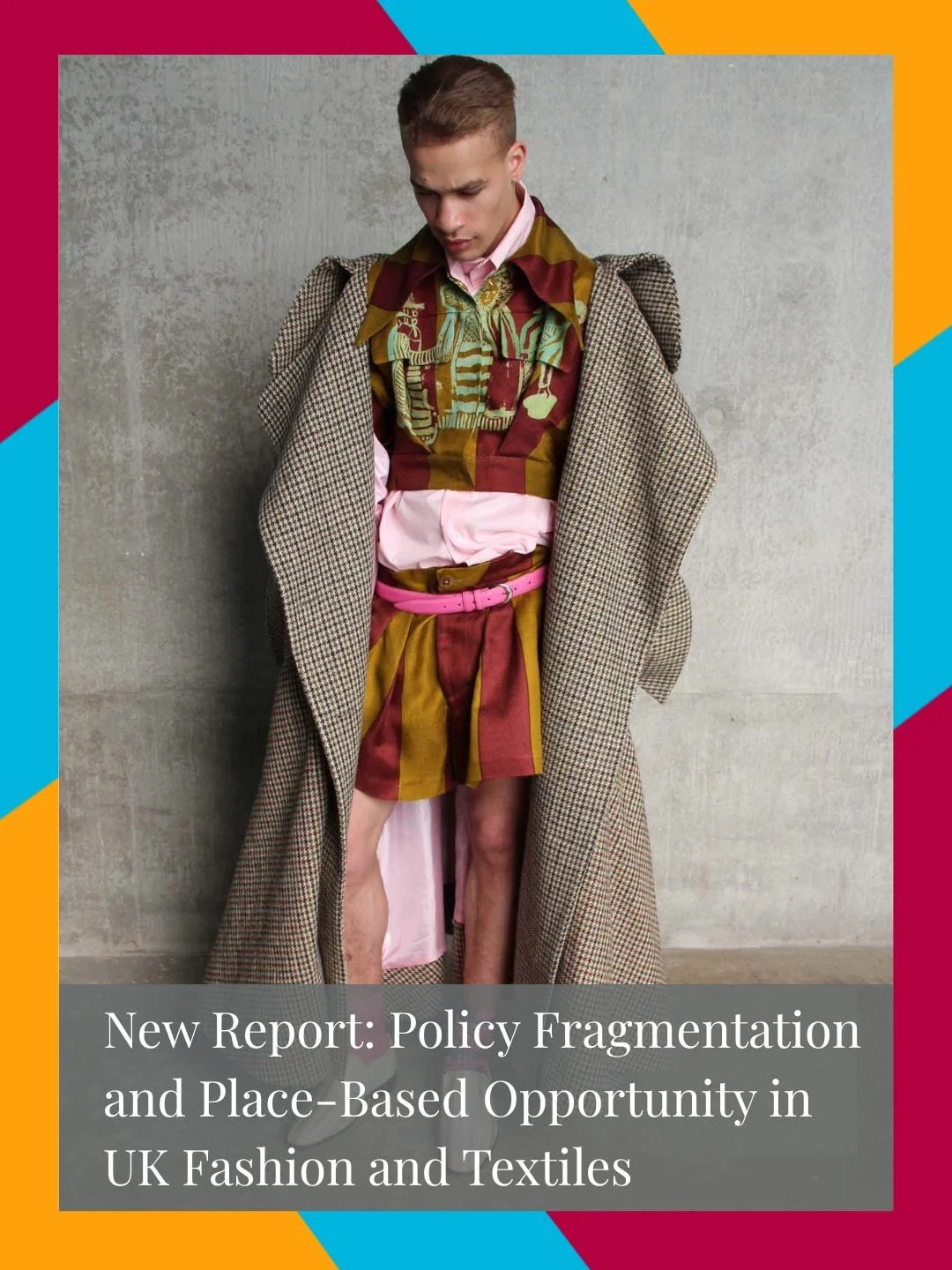
Image of courtesy of Atgof Studio. All rights reserved.
The report finds that the UK fashion and textiles sector is not constrained by a lack of talent, demand or ambition, but by the way it is governed. Drawing on 19 in-depth interviews with industry leaders, policymakers, local authorities and civil society organisations, alongside extensive policy analysis and stakeholder mapping, it reveals a sector that is structurally underserved due to fragmented governance, short-term funding cycles and ongoing ambiguity over whether it sits within creative industries or manufacturing policy.
This lack of coherent positioning has resulted in reduced visibility, inconsistent investment and limited strategic coordination, despite the sector’s clear regional economic significance.
Alongside this diagnosis, the report identifies a critical and underused opportunity: public procurement. Where procurement is aligned with place-based industrial strategies, fashion and textiles can function as anchor infrastructure within local economies, strengthening skills pipelines, enabling innovation and supporting social mobility across the UK’s regions.
Tamara Cincik, Founder and Director of Fashion Roundtable, and co-author of the report, said:
“The thinking behind this report stems from my realisation during the pandemic that the UK had a very disjointed approach to public procurement and a dire need to fix it with a more strategic nationwide and long term approach. I believe firmly that if the UK approached the manufacturing of clothing in the same way as it is aiming to with energy and food, with a more sovereign approach, we would stabilise order books, see greater inward investment and support meaningful employment across the UK seeing a long-term real boost to the economy.”
Alix Coombs, co-author of the report, said:
“Fashion and textiles in the UK is being held back not by a lack of capability, but by a lack of coherent governance. What we are seeing is a fragmented policy landscape that fails to recognise the sector’s true economic and social value. If we align procurement, industrial strategy and place-based policy, we have a real opportunity to rebuild resilient local systems that support both people and production.”
The report calls on government to formally recognise fashion and textiles within industrial strategy, to use public procurement as a strategic lever to stabilise domestic demand and strengthen local value chains, and to improve coordination across national, devolved and local policy frameworks.
This is not a call for special pleading. It is a call for coherence. A sector with proven place-based impact is making the case for smarter, more joined-up governance that reflects its real economic and social contribution.
Fashion Roundtable and the LPIP Hub at the University of Birmingham, led by City-REDI, will continue to convene dialogue across industry and policy to support the translation of these findings into action.
Read the full report:
https://www.fashionroundtable.co.uk/reports
For more information:
Alix Coombs
Strategic Consultant - Organisational Development & Project Design
Fashion Roundtablealix.coombs@fashionroundtable.co.uk