
Why I Am Worried about the Government's take on EPR and PEFCR and What This Means for Natural Fibres such as British Wool .
Harriet Fletcher-Gilhuys on the Alice in Wonderland responses she has had from the UK government and parliament on this issue.
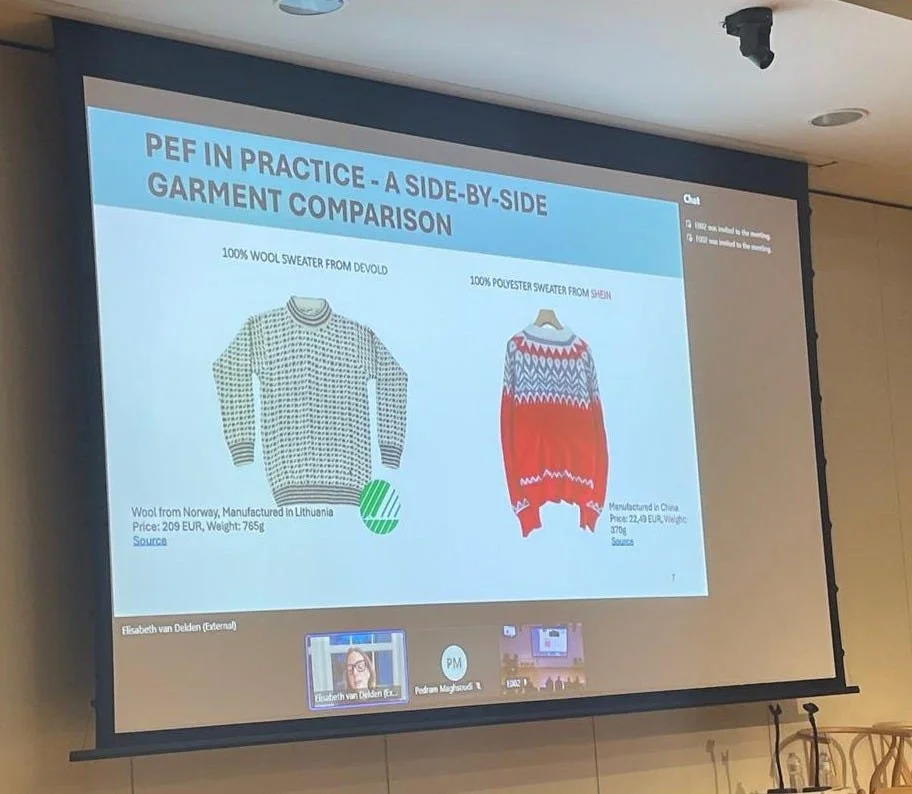
PEF in Practice presentation by Make the Label Count at the recent CSM x Wool Exchange event in London. Image Credit: Harriet Fletcher-Gilhuys
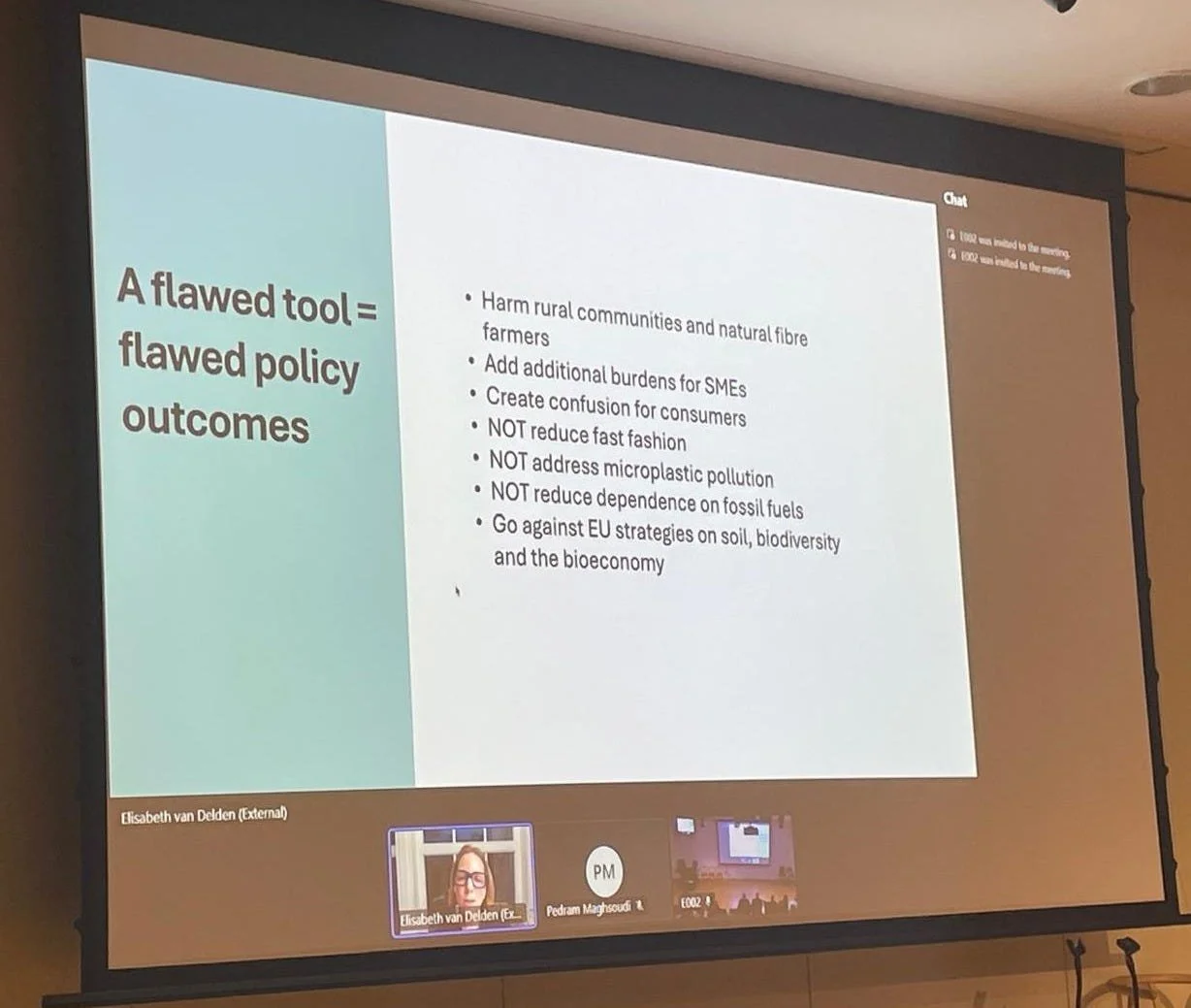
Policy outcomes of PEF by Make the Label Count. Image Credit: Harriet Fletcher-Gilhuys
By Harriet Fletcher-Gilhuys
As Textiles Researcher and lead on The Great British Wool Revival project, which in collaboration with The King’s Foundation, re-mapped a broken system from farmer to designer in the UK supporting British wool and best-practice, I have real concerns about the impact of Extended Producer Responsibility (EPR) and Product Environmental Footprint Category Rules (PEFCR), a life cycle assessment tool launched by the European Commission in regards to its impacts on natural fibres such as wool.
To address this, we requested a meeting with Mary Creagh CBE MP Parliamentary Under-Secretary of State (Minister for Nature) and the DEFRA team and this was their response.
Hi Harriet,
Hope all well? Unfortunately, Minister Creagh is unavailable to join for a meeting.
Have a lovely afternoon.
Tamara then proceeded to ask me:
Ok so there is no capacity for a meeting about natural textiles and farm to design with the Minister?
I am honestly disappointed and surprised.
Is anyone from the team able to meet Harriet to talk about this as it is within your brief.
And this was the response:
We are in a very packed Circular Economy space at the moment.
I can pass on this email to our officials regarding contacting Harriet.
Tamara then suggested that I email the Environment Audit Committee (EAC), which as an opposition MP, Mary Creagh had been the Chair. When she lost her parliamentary seat, Tamara had been instrumental in securing the return to their Fixing Fashion work from the subsequent Chair, the now retired Right Hon Philip Dunne MP, who spoke at our last APPG meeting before the General Election. Indeed, Mary spoke at another APPG meeting we hosted speaking alongside Patrick Grant (of Sewing Bee fame), and speakers from Make It British and Labour Behind the Label.
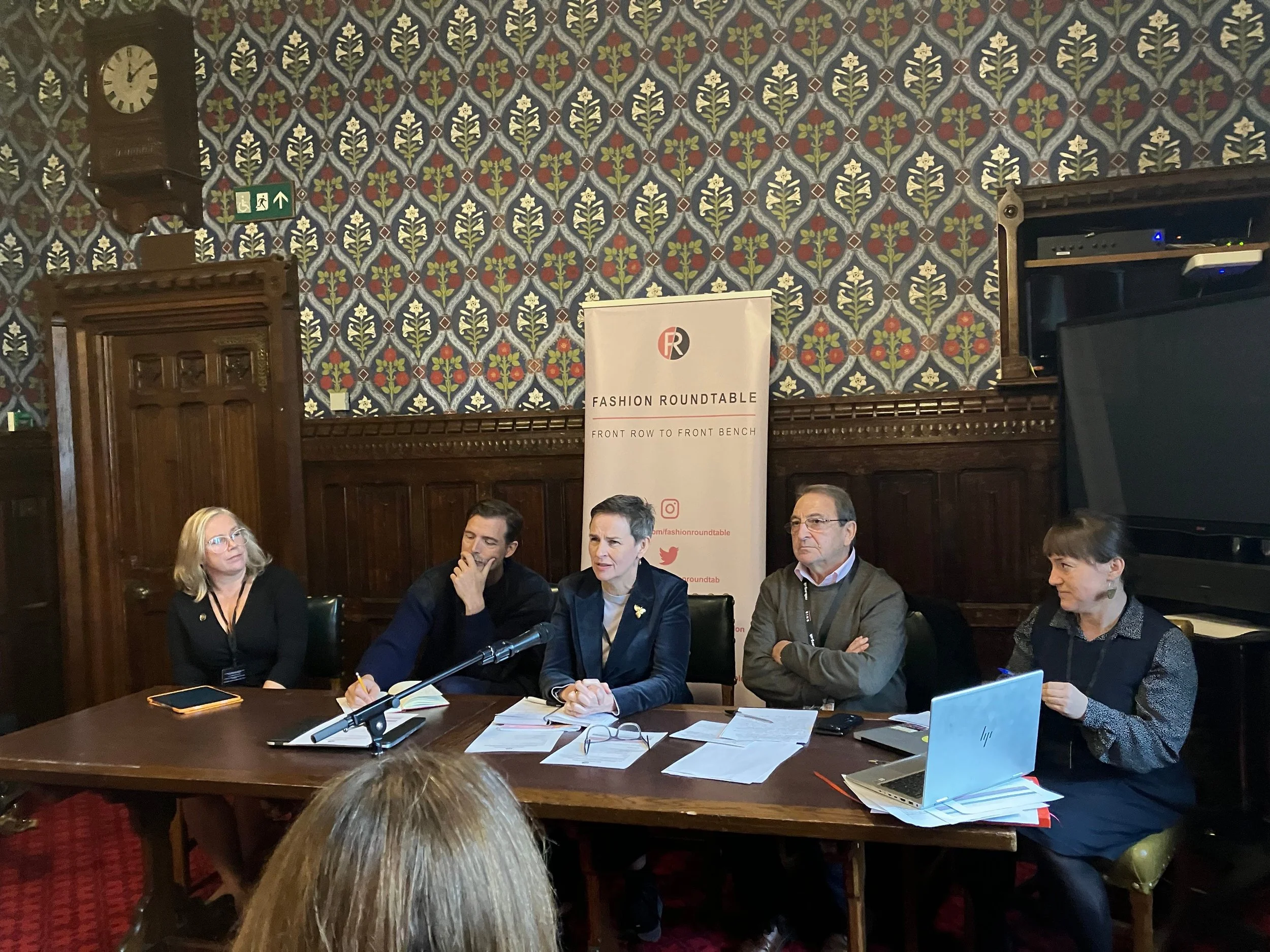
Mary Creagh centre, speaking at an APPG meeting hosted by Fashion Roundtable.
So I contacted the EAC and they suggested that I submit evidence to the Environment in Focus Inquiry, as the Fixing Fashion inquiry is now closed. They recommended that we submit evidence to the The Environment in Focus inquiry. It was recently rejected on the grounds below:
We have been pleased to receive many more suggestions than expected and unfortunately are unable to take yours and many others further forward at this stage.
However, we are very grateful for your suggestion, and we may return to this the topic when considering the Committee’s next inquiries and wider scrutiny work.
I am really concerned that rather than looking at our issues on EPR and PEFCR, the government will ignore this and continue to promote the current metric system that will inevitably incentivise synthetics, fast-fashion and further greenwashing claims.
As a textiles researcher I have grave concerns that not only is there no clear focus from any of the parliamentary committees on fashion, there is even less on textiles. Added to this, I am really concerned that sustainability measures are aligned with recycling. In the EU we have an Alice in Wonderland reality, where polyester scores higher for Extended Producer Responsibility metrics than wool! Biodegradability is being erased as a measure of sustainable success.
The EAC EPR and PEFCR work towards a metric system that promotes recyclability as its key scoring metric with natural fibres and biodegradability scoring much lower. The argument is that biodegradability is misleading in real-time scenarios, such as lack of land space, lack of scientific testing and data and its inability to be applied across multiple countries in the EU which are already set up with core recycling centres. PEFCR is also based on a cradle to grave life cycle assessment rather than cradle to cradle which incorporates the entire eco system including soil health and biodiversity.
If the textile EPR scheme adopts France’s eco-modulation approach, where producer fees are adjusted to encourage the use of sustainable materials it could unintentionally drive greater reliance on synthetic fibres. Producers may focus on circularity and recyclability to lower their fees instead of tackling the underlying problem and reducing the use of synthetics.
I recently attended the CSM x Wool Exchange event where Elisabeth van Delden, Wool & Sustainability Specialist (Make the Label Count) spoke about PEF and wool legislation and raised similar concerns.
Read below my written evidence that I submitted to the Environmental Audit Committee:
Concerns regarding the Extended Producer Responsibility scheme for textiles and the Product Environmental Footprint Category Rules, particularly in how natural fibres such as wool, cotton, and hemp are evaluated compared to synthetic fibres.
As Secretariat for the All-Party Parliamentary Group for Ethics and Sustainability in Fashion, Fashion Roundtable is the leading think-tank and change agency delivering consistent thought leadership across the sector. We have regular conversations with stakeholders across the value chain, from government to farmers and business leaders, and we seek regular feedback to drive policy change. We are submitting evidence based on our stakeholder engagement as Fashion Roundtable and not as the secretariat for the APPG.
We have significant concerns around the EU’s Extended Producer Responsibility (EPR) Scheme for Textiles and the Product Environmental Footprint Category Rules (PEFCR), recently launched by the European Commission. The PEFCR aims to establish a comprehensive environmental metric system to guide fibre selection and support credible environmental claims, while addressing the issues of greenwashing.
However, both the EPR scheme and the PEFCR rely on a methodology that raises concerns. In the current eco-modulation framework under the EU EPR for textiles, which is currently being researched for a similar UK scheme, performance indicators such as recyclability, durability, and reparability are weighted more heavily than biodegradability or natural fibre content. As a result, synthetic fibres such as polyester often score higher than natural fibres like wool.
The PEFCR applies a cradle-to-grave life cycle assessment based on a linear economic model. While it promotes circularity, in practice it may inadvertently reinforce mass consumption and short-term solutions, rather than supporting long-term regenerative practices.
It is vital that biodegradability is factored into this metric system, as the current framework rewards polyester over wool for its recyclability, unintentionally incentivising greater use of synthetic fibres.
We urge the UK Government to undertake a comprehensive review of this environmental metric system, to ensure it delivers fair, and evidence-based outcomes for both synthetic and natural fibres.
If you agree with us on this and would like to speak to DEFRA we recommend that you reach out to ps.mary.creagh@defra.gov.uk or directly email the Environmental Audit Committee directly at EACOM@parliament.uk.
Please also add your comments below or write to me directly at The Great British Wool Revival here, we would love to hear from you.
Thanks,
Harriet