
Morality, Spirituality & Sustainability: In Conversation with Simon Whitehouse
Interview by Meg Pirie
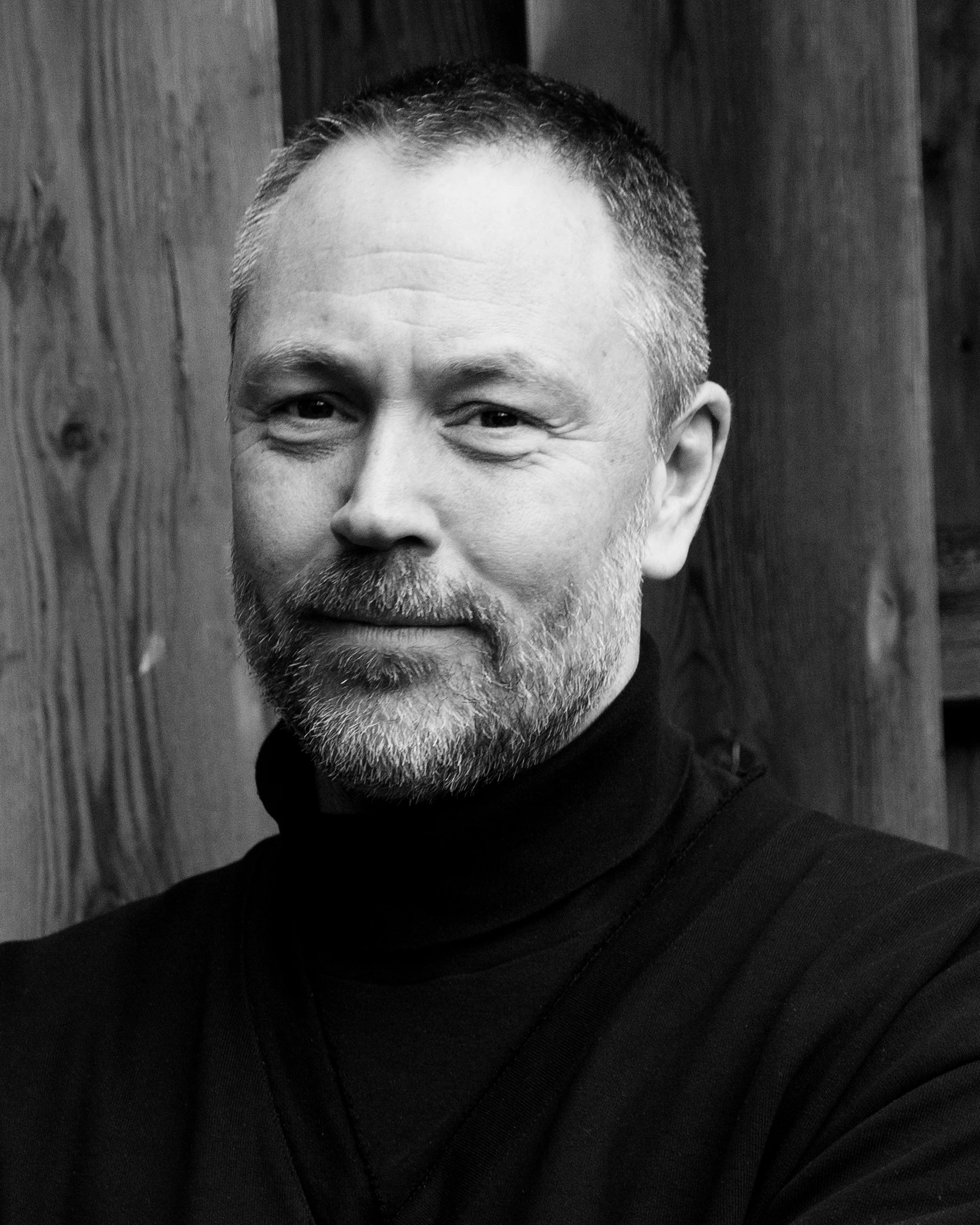
Image of Simon Whitehouse. Credit: photographer Mauro Maglione
It’s a balmy spring evening when I first chat to Simon Whitehouse over Zoom. I’d been a bit nervous to speak to the person whose career trajectory has been so impressive. To put it lightly, Simon is an industry veteran. After chapters in New York with Donna Karan, and in Italy with Renzo Rosso, Simon has held a number of senior positions for global fashion brands. He became the youngest CEO at LVMH for Jonathan Anderson – leading a period of unprecedented growth and critical acclaim for the brand. However, as soon as Simon started chatting his northern accent put me right at ease. Growing up just a couple of hours from my home town in Wales, we spoke at length about Simon’s background, his agency, EBIT™ and his passion project of getting creatives back into work, for no other reason than to cultivate, “more good humans”, as Simon put it. Simon is someone who speaks about morality, sustainability and spirituality with such realness, someone who truly lives their values. His aim of cultivating an inclusive community at a time where there is an ever-increasing siloed approach to society and where burn-out and mental health crises are on the rise, is centred on truth and authenticity. What follows is one of those conversations. Enjoy!
Disclaimer: The following content contains mature language, which has not been edited to retain authenticity.
Let’s start at the beginning. Can you delve into your roots in Stoke for us? At that time, did you ever imagine becoming the youngest CEO at LVMH?
Stoke-on-Trent is often labelled as the worst place in the UK to live on every social-economic level. It’s also a BNP stronghold. Extreme working class, and often a closed/local mentality. My Dad was from Moss Side, Manchester (a dangerous place) and used to take my brother and me to Manchester all the time to meet his friends, family, and watch the football. Stoke is so local-centric that not many people leave (Robbie Williams and Slash being anomalies!). But my Dad always told us there was a bigger world out there, big cities like Manchester and London.
My Dad is second generation Irish, and back then with the Troubles (with the IRA) the Irish shared community space with immigrant communities in Manchester, for example the Caribbean communities – black, brown and white Irish people living together. This multi-cultural value system was instilled into me from my father who always told us to look beyond the colour of someone’s skin and look into their eyes – for the eyes are the windows into the soul and morality of a person.
As a teenager I went off the rails after the sudden break up of our parents and the mental breakdown of my brother. For a few years I was mixed up in some bad things, sometimes violent things, and bouncing around the club scene where ecstasy was prevalent. During this period of my life I was in total self-destruct mode so couldn’t imagine anything other than total black-out escapism, let alone being involved with the likes of LVMH one day.
A fateful thing happened and I moved suddenly to London to get away. I didn’t care what I would do – I just needed to get away. We’re all geniuses in hindsight and now I can look back and understand that I had a lot of unresolved trauma from that period which was manifesting in very unhealthy ways.
The year 1999, I somehow got a job at Camper in London, but I could have easily got a job absolutely anywhere to be honest – cleaning windows, laying bricks. I didn’t care. It just happened. But culturally we (our group of lads) were always quite progressive, in front as it were, in terms of fashion, music, club scene, etc so the intersection of these things is in my blood. Camper promoted me quickly and then I went to DKNY. Then they made a job for me in New York when I was just 27 working next to the President cross-functionally on every touchpoint in the business 360 degrees. It all just went very quickly because it was all so natural and to be honest, easy. I never felt like I worked a day in my life. Easy maybe for a white male to say – I am conscious of that. I left LVMH/Donna Karan and New York to go back home to be with my terminally ill father in Manchester in 2006. Fast forward to 2014 and I re-joined LVMH as the first CEO of JW Anderson.
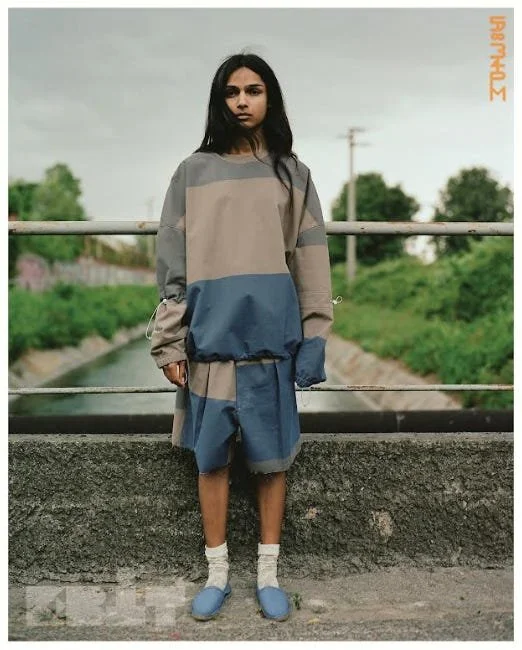
EBIT™ BREAKDOWN [E250]
You’ve been at the very top of high-end luxury business as CEO for the likes of JW Anderson and Modes. Looking back, what did reaching that albeit ‘traditional’ pinnacle of success feel like?
Hubris can take effect. It’s like a drug. External validations inflate one’s own ego, and without consciously knowing it, one can get slowly addicted to it. It can feel very good – you’ve made it. At the same time, for me it also became like “is this it?”. After all that, is this what it is? I don’t mean to be ungrateful. I worked hard and achieved a lot, and was fortunate to meet and befriend many great people and build great teams. But somehow the calibration of my life 360 was not right. Being a hyper-functioning OCD-fuelled workaholic is gonna have some consequences somewhere! And by the way, nobody prepares you for the switch from a specialist vertical discipline (sales, finance, legal etc) into the horizontal role of CEO/General Management. It just is what it is and you figure it out basically alone. When you’re there you begin to realise that everyone is just figuring it out themselves, with their own weaknesses and insecurities.
For me, I had a Damascene moment in my life early 2017, which provoked me to leave not only JW Anderson and LVMH, but my life overall as it was. I had a spiritual intervention, maybe from my father who passed in 2006, which gave me the message: “this is not you, this is not your path” – and to this day, I still do not understand what that intervention was. Never happened before or since. It was not a voice, nor a feeling. Somehow a different kind of possessed sensation. But it course corrected me onto a path of complete openness to be the spirit of the 5 year little boy Simon, and I’ve been walking that path ever since.
In your corporate career you have advised some of the biggest brands on sustainability. Can you point to a specific point in time in which morality and profitability overlapped? Can there ever be a balance between the two?
We all know that sustainability is such a ‘nothing’ umbrella term. If we sustain what we are doing we’re beyond fucked – as we’re already fucked and in decline/deficit. What does the science tell us now – that we are way beyond like 6 of the 9 planetary boundaries. The science and the visibility of this is indisputable. The narrative and the actions need now to be towards regeneration and a circular economy. And to absolute accountability – fast. Let’s break down sustainability – most people start with climate (carbon, ozone, biodiversity etc), but there’s also social justice – people. Fundamentally, the initial concentration is on Planet and People.
But go deeper, go into the SDGs (remember them? – that nobody seems to care or talk about anymore?), and there is a critical aspect of “sustainability” which is:
“To pay the right amount of taxes, in the right places, at the right time.”
Fundamentally, this refers to the sophisticated forms of global/international tax evasion and tax avoidance. This point for me emphasises the conflict between morality and profitability. Just because you’re a billionaire and can play the intricate global system of international taxes, to pay zero in corporation tax does not mean that you should. That’s morality and ethics. The most philosophical quintessential question of being – our purpose – and where on the dial of individualism and collectivism one’s moral compass directs. This is where governance should come into play, because “the avarice of man is insatiable” – Aristotle.
You were CEO of Eco Age for a time. Did this position shift your perspective at all?
It did not shift my perspective. It only added real experience and knowledge, both professional experience and academic learning, to my feelings about morality, ethics, people and planet. To work alongside Livia Firth and Nicola Giugglioli was a true highlight of, not only my career, but my life, also on a spiritual level. Really incredible and pioneering human beings.
Can you tell us more about your consultancy SIMON WHITEHOUSE SRL – does this represent a shift into building your own independent advisory ecosystem?
It’s happening already. It all happened totally organically through being approached by certain collaborators, for projects, coaching, mentorships, non-exec advisory roles. Same time, since I am no longer in a “full-time employment”, since MODES went into liquidation (similar to Matches, SSense, Saks, and many more!) and I have this feeling to be unfiltered in my public speech and profile, there is so much kinetic energy bouncing around.
People are tired of lies. People are tired of wearing masks and working as if in some form of mental slavery. Never before has authenticity, truth, and ethics been so needed and desired. And so this intersection of ethics, truth, circular economy, with culture and fashion/luxury/sports (my work “sectors”), on levels from Boards/CEOs/C-Suite/Founders right the way through to individuals and students/interns – it’s fascinating. I have a wheelhouse of several projects and collaborators.
I have been a CEO for 12 years across London, New York, Milan, in 5 different companies, different lenses, different business models, and with so much life experience across different socio-economic migration, and multi-cultural demographics, I have a unique prism of experience that people find to be a reservoir of support for their needs.
My practice is constantly looking and anticipating areas where the Board or CEO may not have the bandwidth to be strategically and/or morally anticipating for themselves. And that’s very valuable, and it’s clear the crisis in the industry is forcing many brands/groups/companies/CEO’s to be quite reactive or put all their eggs into traditional baskets.
It is psychologically and neurologically proven that when humans are afraid, anxious, or facing uncertainty, they tend to revert to familiar behaviours, routines, and thoughts, even if those familiar things are detrimental or uncomfortable. This phenomenon is driven by the brain’s survival mechanisms, which prioritise safety and predictability over growth and new experiences. And this is happening a lot right now today in the fashion/luxury industry!
EBIT™ BREAKDOWN [E250]
You founded EBIT™ (Enjoy Being In Transition™) as a collective which emerged in part to progress the dialogue on mental health in the fashion sector. Can you unpack the evolution behind this?
I was having a tattoo, my mother’s last words to me “I am now”, in December 2019 as part of a ritual my wife and I were doing every year to have a tattoo to symbolise a significant event that happened that year. My Mrs was pregnant with our first child so she wasn’t there on this occasion. Anyways, I had the tattoo on my ribcage and, still topless, looking into the mirror of the tattoo shop I felt an eerie shudder. I went afterwards immediately to get a pint of Guinness (typical thing for me to do after getting a tattoo), and I suddenly became obsessed in my mind on repeat, like a loop, of the words:
“the most profitable brands will all be directed by their moral compass”.
I got a pen and paper from the barman of the Smith Street Social in Brooklyn, and began writing the sentence over and over, like “lines” we used to do at school when we were naughty.
In the following months I couldn’t put this sentence out of my head, and I began to unpack it and evolve it into an artistic project which it still is, and now we also do clothing. The whole thing EBiT – Enjoy Being in Transition – is an open exploration of how extreme capitalism has affected our mental health. We only collaborate with neurodivergent people. Every creative expression is rooted in or references of mental health. I describe it like, think of Patagonia and you think of a value system and ethos of the climate, the environment. Think of EBIT and you think of truth, of mental health, neurodivergence, and authenticity of humanity.


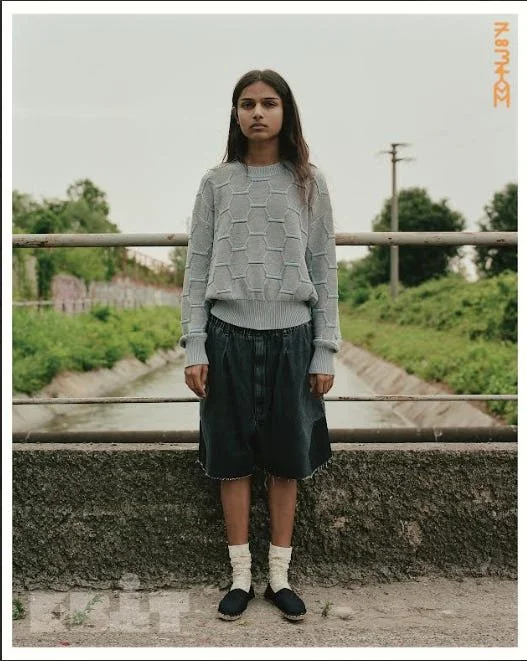
EBIT™ BREAKDOWN [E250]
EBIT™’s approach is not just about selling clothes, but a multi-sensory approach such as music mixes alongside clothing drops, as well as poetry. How does this foster human connection and why is this important in an increasingly siloed world?
It’s like a cultural mirror. People gravitate to either opposites or similarities. It’s how we evolve as children, mirroring images, mirroring speech. It’s the most fundamental human activity. And it’s essentially how tribes and cultures are born and bonds are built. Nothing really exists in the fashion space which has these values of truth, and ethos of mental health. There are some “merch” brands that may have slogans or logos on – kudos (said, sarcastically), but there is nothing out there that explores these themes with absolute artistic freedom and authentic truth.
That’s where I felt EBiT could become very powerful – like a silent solidarity. A tribe of people, who when you see they are wearing EBiT then you know deep down there is a connection with truth and neurodivergence. There is a shared culture.
The very first person who bought something from the EBiT web platform (which only opened in January this year) wrote to me personally a 10 page handwritten letter about how touched they were that they felt seen by a brand for the first time ever. They were recently diagnosed with ADHD and with autism, and they could not believe that there was a brand like EBiT existing out there and it touched them deeply. And for sure it touched me deeply to receive their letter. It was a sign to me of the powerful solidarity that we can create when other brands are having their entire identity questioned during this period of radical transparency and authenticity.
How does EBIT™ select artists to ensure their lived experience with mental health is authentically represented?
Hmm. We don’t really select. It just happens totally organically and naturally. Everything on total kinetic feeling. Entropy as it were. One thing leads to another. One person leads to another. Consequential causes and effects. The spirit and an explicit reference point is Factory Records, and their spirit of absolute anarchy and artistic freedom. I never even wanted EBiT to be a company. I wanted it cash or Venmo on the dark web to be honest. The spirit was always more important to me than pieces of paper. The collaborators all I guess orbit in conversations and dialogue with myself, and we shed tears. Every human being that has or is still involved with EBiT is neurodivergent – privately or publicly. Every one has heartfelt experiences with themselves or loved ones: suicide, autism, depression, bipolar disorder, schizophrenia, you name it. I have no piece of paper to prove these things – only the tears of truth that we share intimately and in private.
Let’s talk about the way in which you have bypassed traditional recruitment barriers by using your personal network to help those who are unemployed back into the work. I understand that this is a completely personal passion project – how did this come about?
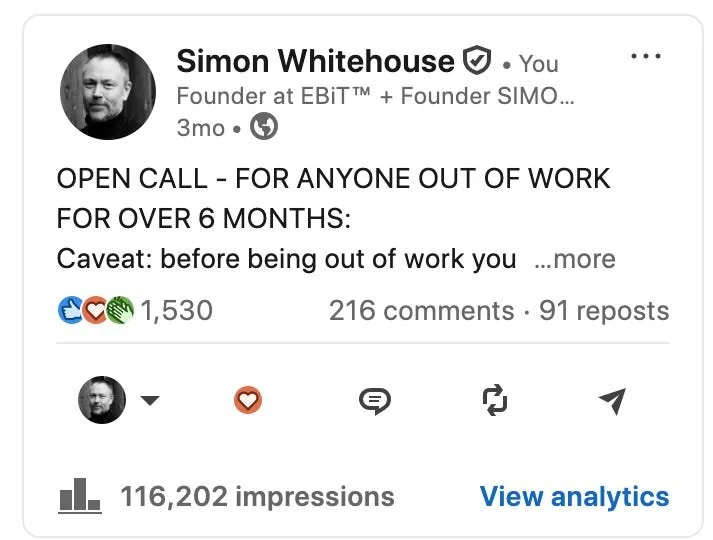
The second day back at my desk in January and I received 3 separate emails from friends/acquaintances of mine each essentially saying the same thing: “I’ve been out of work for 6 months now and don’t know what to do, if you have any ideas or advice etc”. And it triggered something in me that provoked me immediately that day to put out an OPEN CALL on my LinkedIn for people in similar positions – those out of work for over 6 months. I asked others to send me their details, their resume, and I would filter the ones relevant to my network and share the profiles publicly (anonymously) from my LinkedIn account. I am not a mega influencer (LOL) but I do have a network of 25,000 top executives from fundamentally every fashion, sports, luxury brand in the world – therefore great exposure to those who need it. Someone sent to me a quote in the first few days:
“DO WHAT YOU CAN WITH WHAT YOU HAVE WHERE YOU ARE”, and I took this on as the spirit of the whole initiative.
For one month over January-February I set my alarm at 5am and spent a couple of hours per day sharing profiles, responding to every human being who sent a message to me on LinkedIn. I started to receive these incredible stories, so profound, of how lives have been affected by the crisis of unemployment in the fashion/luxury sector. And then companies started to contact me to be introduced to profiles, and then also companies started sharing their open job roles with me and I started to share them too. Fuck it, is what I thought. It was quite addictive for a couple of months! The whole thing was getting over 250,000 views per week, like 1 million views per month over LinkedIn, and many people in Milan stopped me in the street and said it was amazing what I was doing. It was a little surreal for a moment, especially because I did it so instinctively without properly thinking. When I started to get a lot of messages and resumes, I just set up a system to filter/copy/paste things so that I could manage and keep professional communication. I just set up 3 files on my desktop, each titled: “GET PEOPLE JOBS.”
The truth is, since MODES went into liquidation beginning 2025, for most of 2025 it was a real financial struggle for myself personally, affected by the disaster of MODES both for my brand EBiT (MODES was the sole wholesale partner at the time just launching!), and for myself, my family. But, my mother – such a strong woman, who worked on the factory floor for 40 years, never asked anyone for help, and I am the same way inclined. I will figure things out myself. So when I received these emails on the second day of January, I just thought “fuck it’ – someone needs to do something because the system seems fucked. I immediately thought of my Dad, and how he used to tell me:
“Listen kidda, in life you will encounter bad stuff – it will happen – but there are no problems. There are only challenges to be overcome. It’s your responsibility in your life to look in the mirror and face it. Take whatever negative that is in your hands and flip it immediately into some kind of positive – for you, or for someone else. Do that, and you will always be OK”. So, that’s what I did.
Then it became really clear that the system is really messed up. That there are great jobs available and there are great profiles available, but the system was really slow to make connections somehow. Companies are using headhunters/recruiters less to save money, but their Talent/HR departments are totally equipped to manage it all. Thousands of people, literally thousands, mentioned to me the “ghosting” of HR people and recruiters, just not replying to anyone for weeks, months, ever. It was clear that the whole thing touched a nerve.
Tons of people offered to support me, and/or to turn it into a business, but that was never my spirit or intention. “Do what you can with what you have where you are” – that is the spirit. Maybe I will do it again in the future. God knows. It was a weird kind of fun, and I met a lot of new amazing people through the whole process too. I used it to push people to think about how they show up on LinkedIn too – selfish or selfless – that balance is important!
Finally, can you share a success story with us, perhaps a simple LinkedIn message that you’ve sent which has completely changed someone’s career trajectory?
As far as I know we got 1 person a job absolutely directly as a result of it. But also got over a hundred meetings, many of which are still ongoing processes which may lead to jobs. Moreover, it was the ‘Butterfly Effect’ which you can see from the messages screenshot here in terms of the impact.
Take a look…
With love,
Simon
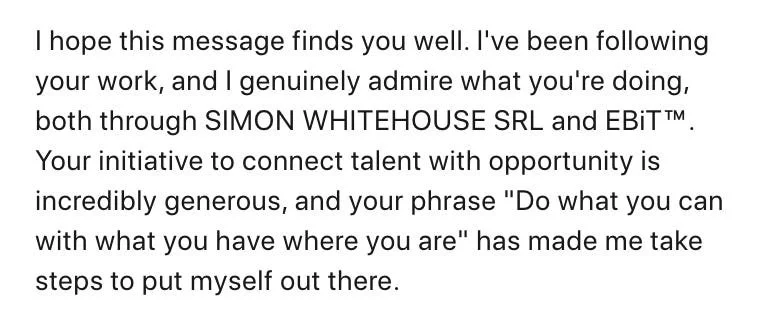
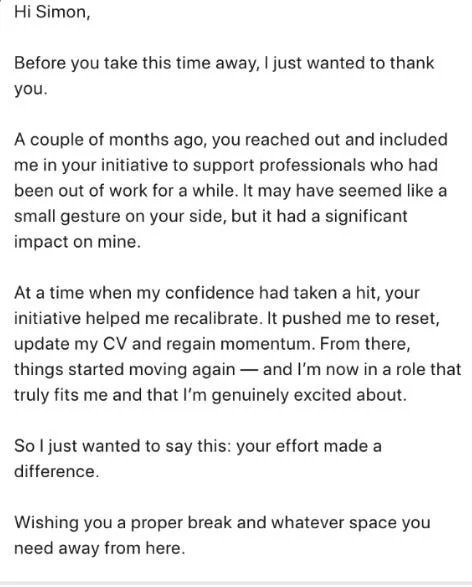
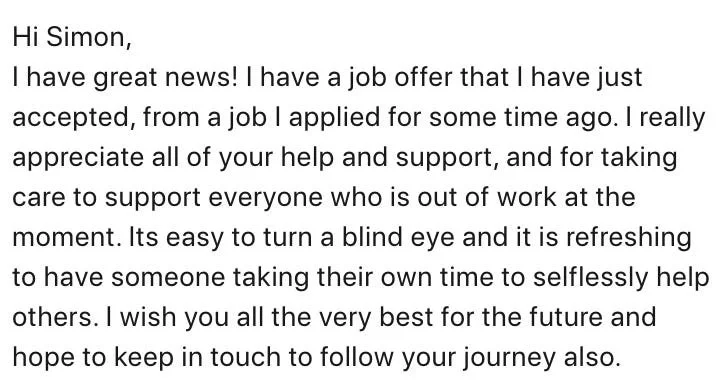
Screenshots of the 'Butterfly Effect' - click through....