
By Tamara Cincik and Alix Coombs for The LOCAL POLICY INNOVATION PARTNERSHIP HUB, led by City-REDI at the University of Birmingham.
Ever since the pandemic, when I was advising the national government pro bono, supporting initiatives such as the Emergency Designer Network when fashion designers and brands made scrubs to help mitigate the shortage and overwhelming demand for PPE, it was apparent to me, that we need to address the value of on-shoring the manufacture of UK made public procurement policy, as a long term driver of growth and economic nationwide stabilisation.
This is the first of two reports we are delivering as part of my LPIP Fellowship, where I worked closely with Alix Coombs from my team, and it shows not only Fashion Roundtable’s commitment to on-shoring manufacturing, it also evidences the economic value at a local, regional and national level.
Tamara Cincik.
Executive Summary
This report examines how the UK fashion and textiles sector is positioned within national, devolved and local policy frameworks, and what this positioning means for its ability to function as a stable, place-based economic system that supports skills retention, inclusive growth and regional resilience. Conducted as part of the Local Policy Innovation Partnership Hub, the research uses fashion and textiles as a case study through which to interrogate the effectiveness of place-based industrial policy in practice. Drawing on desk-based policy analysis, stakeholder mapping and 19 in-depth interviews across the sector, the report identifies a persistent gap between policy ambition and delivery, and sets out actionable recommendations grounded in local realities while remaining scalable across the UK.
The central finding is that the sector’s fragility is not driven by a lack of capability, demand in principle, or entrepreneurial activity, but by structural instability produced through fragmented governance, short-term policy interventions and weak coordination across policy domains. Fashion and textiles occupy an ambiguous position between creative industries and manufacturing, resulting in dispersed responsibility across departments and levels of government. While this hybridity is often framed as a strength, in practice it has limited the sector’s visibility within industrial strategy, inward investment and innovation policy, particularly in relation to labour-intensive, place-based manufacturing.
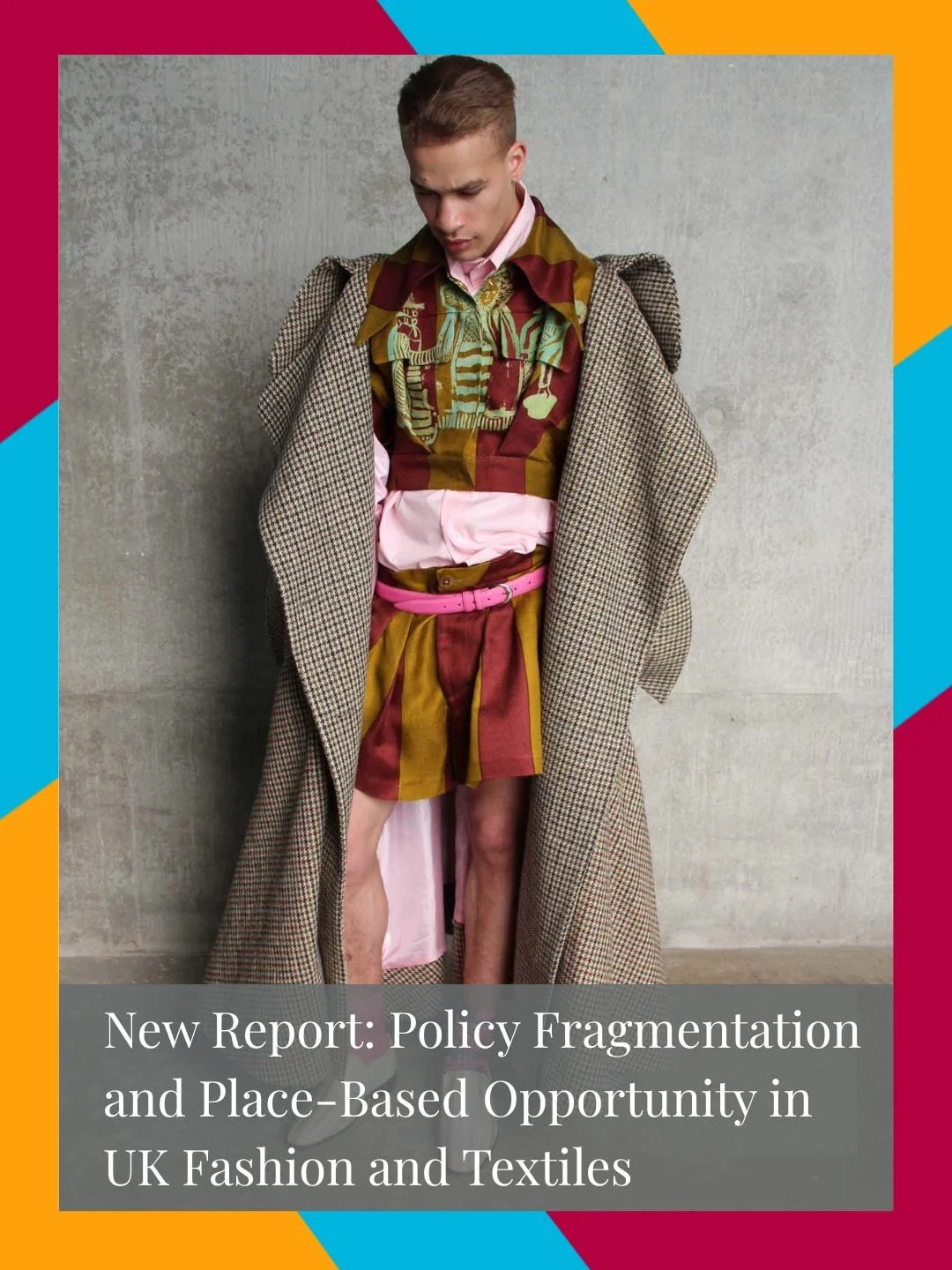
Image of courtesy of @atgof_studio. All rights reserved.


At the national level, fashion is primarily recognised through creative industries frameworks that prioritise design, intellectual property and export growth. Manufacturing policy, by contrast, tends to focus on capital-intensive or technologically advanced sectors. This division leaves domestic fashion and textiles manufacturing marginal within both agendas. Although national rhetoric increasingly emphasises reshoring, supply chain resilience and the strategic use of public procurement, the mechanisms intended to deliver these objectives have not consistently reached the SMEs, manufacturers and intermediaries that underpin domestic production. Industry data and interview evidence point to declining revenues, erratic demand and limited access to long-term contracts, particularly since Brexit and the Covid-19 pandemic. These pressures undermine workforce stability, skills transmission and investment in productive capacity.
The research highlights public procurement as the most significant underutilised lever for addressing this instability. Across interviews, procurement is repeatedly identified as one of the few policy tools capable of delivering predictable demand at scale. Where procurement frameworks have supported local or regional production, they have enabled manufacturers to plan, retain staff, invest in skills and improve labour standards. Conversely, fragmented, opaque or scale-biased procurement systems have reinforced precarity and excluded smaller suppliers. The report finds that relatively modest reforms, including longer-term contracts, clearer forecasting, accessible contract sizes and improved payment terms, could materially strengthen local value chains while delivering social value and value for money.
At subnational level, the research identifies greater recognition of fashion and textiles through lenses of heritage, craft, skills and placemaking, particularly within devolved governments. Scotland, Wales and Northern Ireland each demonstrate more place sensitive approaches than those evident at UK level, although these remain uneven and often constrained by funding uncertainty and limited coordination with national policy. Combined authorities and local governments increasingly position creative industries as engines of inclusive growth, creating space for fashion and textiles initiatives even where the sector is not explicitly prioritised. However, the absence of consistent sector recognition means that interventions are often fragmented, dependent on individual champions and vulnerable to shifts in political leadership or funding cycles.
Across all governance levels, the findings underscore the importance of local manufacturing as anchor infrastructure within wider economic ecosystems. Fashion and textiles manufacturing supports interconnected networks of training providers, logistics, maintenance services, compliance expertise and design activity. Where production capacity is stable, these activities cluster locally, generating multiplier effects and opportunities for inclusive innovation. Where manufacturing is unstable or absent, skills leak from the area, value chains fragment and local authorities lose the capacity to intervene meaningfully. The report therefore reframes manufacturing not as a standalone sector, but as enabling infrastructure that underpins broader economic and social outcomes.
Skills retention emerges as a critical challenge, but one that is best understood as a consequence of instability rather than a discrete policy failure. Interviewees consistently
link skills loss to insecure demand, limited progression pathways and poor job quality. While the sector offers accessible entry points for communities excluded from other industries, the absence of long-term investment risks reproducing low-paid and insecure work rather than delivering social mobility. The research indicates that effective skills policy must be aligned with procurement, inward investment and labour standards, with local authorities playing a key role in coordinating training provision around real employment opportunities.
Taken together, the findings demonstrate that effective support for fashion and textiles requires coordinated action across governance levels. The national government is best placed to set coherent conditions for procurement reform, inward investment and policy alignment. Devolved governments, combined authorities and local partnerships are essential for translating these conditions into place-based growth, resilient value chains and inclusive labour markets. The report’s recommendations therefore foreground public procurement as a stabilising mechanism, while also calling for clearer sector recognition, ecosystem-focused inward investment, shared local infrastructure and stronger coordination between industry, education and policy actors.
The report concludes that the question facing policymakers is not whether the UK can afford to support fashion and textiles manufacturing, but whether it can afford the long term economic, social and skills costs of continued underinvestment. By aligning national levers with local delivery and using procurement strategically to stabilise demand, fashion and textiles can function as a sustainable, geographically rooted economic system that contributes to resilience, social mobility and regional renewal.