
What the Policy Map Misses and Why UK Fashion and Textiles Deserves Better
An exploration of Fashion Roundtable's latest report on sustainable economic growth and social mobility for the sector.
By Alix Coombs, Strategic Consultant – Organisational Development & Project Design
I come from a background in international development, where I spent years working in contexts where the gap between policy intent and lived reality is wide and full of very real consequences. Where stakeholders in suits make commitments that seem like they’re going to change the world on paper, but in reality, fail to reach the people and places that need them most. Where fragmented governance quietly erodes what investment is working to build.

I did not expect to find the same dynamics in the UK fashion and textiles sector, but that I did.
Along with Fashion Roundtable’s Founder and CEO, Tamara Cincik, I recently co-authored Policy Fragmentation and Place-Based Opportunity in UK Fashion and Textiles as part of Tamara’s Fellowship with the Local Policy Innovation Partnership Hub. The LPIP Hub, funded by the Economic and Social Research Council (ESRC), the Arts and Humanities Research Council (AHRC) and Innovate UK, and led by City-REDI at the University of Birmingham, exists precisely to close the gap between research and real-world policymaking. I am grateful for their support and for the framework the Hub provided, which gave this work the rigour and reach it deserved.
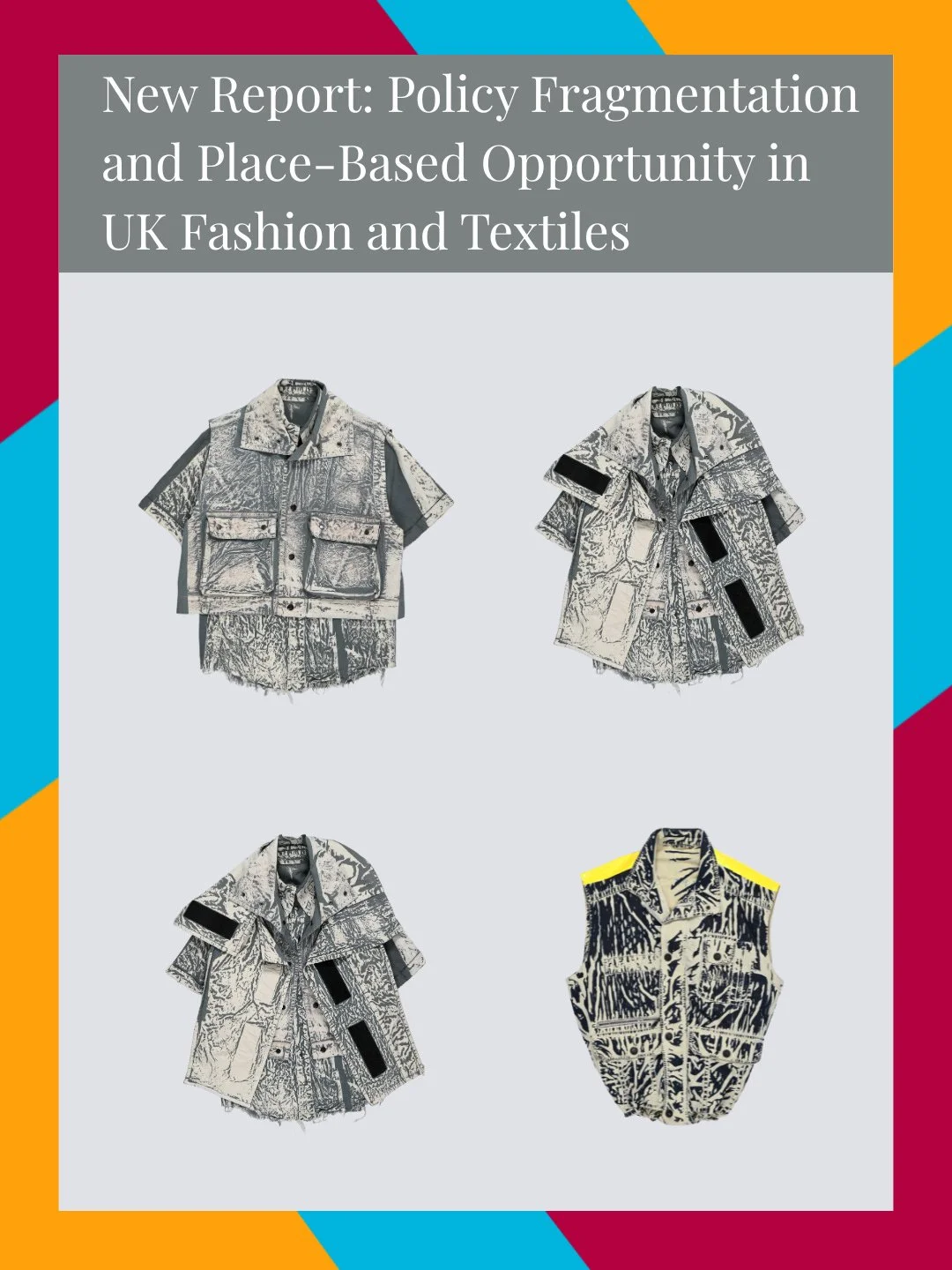
The research drew on 19 in-depth interviews with manufacturers, SME fashion businesses, trade bodies, non-profits and academics across the sector, alongside a comprehensive policy landscape review spanning national government, devolved administrations, and combined and local authorities. What emerged was a picture of fragmentation, underpinned by a failure to invest in an industry that generates far more for the UK economy than it’s ever given credit for.
The sector is not failing because it lacks capability
This is the point I want to start with, because the narrative around UK fashion and textiles manufacturing is too often one of decline, as if the sector is simply succumbing to a natural selection of sorts. That framing is wrong, and it matters that we say so.
The businesses I spoke to are highly skilled, entrepreneurial, and deeply committed to UK production. The communities around them in Leicester, the Midlands, the Scottish Borders, Wales and all over the UK have centuries of knowledge, tradition, and supply chain infrastructure. This is not a sector running out of opportunities, it is a sector being structurally failed.
Throughout this research I documented the growing instability caused by erratic demand, cancelled contracts, declining revenues, and workforce precarity, all of which are consequences of fragmented governance and short-term policy thinking. UK SME and micro fashion businesses saw an average sales revenue drop of one-third in Q4 2024. One manufacturer we interviewed described their Covid-era PPE contracts as providing the most stability their business had ever experienced. A public health emergency briefly delivering what ordinary policy could not is not a success story, it is direct evidence of policy failing to support business.
The problem of not quite fitting anywhere
Fashion and textiles sits awkwardly between creative industries and manufacturing in UK policy frameworks. At the national level, the Creative Industries Sector Plan positions fashion primarily through the lens of design, intellectual property and export. The Advanced Manufacturing Sector Plan focuses on capital-intensive, technologically advanced sectors. Neither fully claims domestic, labour-intensive fashion and textiles manufacturing as its own.
The result is dispersed responsibility and limited visibility. The sector supports over 700,000 jobs and contributes £26 billion in gross value added, and yet it barely registers in national industrial strategy. The Department for Culture, Media and Sport’s definition of creative industries frontier sectors, used to determine where investment flows, does not include fashion or textiles manufacturing at all. It includes video games and advertising, but not the factories in Leicester that have been clothing this country for generations.
This issue is exacerbated by a lack of coordination for the sector. Research participants frequently raised the challenge of not having clear representation, and how the various groups who represent them on paper rarely represent their interests in reality. This adds a significant layer of difficulty to the sector being heard, where there is no clear point of contact who can cut through the noise to offer a meaningful platform for engagement.
This is not an abstract classification problem. It has real consequences for which businesses receive investment, which regions receive support, and which workers have access to stable, fairly paid employment.
What place-based thinking actually means
One of the central arguments of this research is that fashion and textiles manufacturing is not simply an industry - it is anchor infrastructure. Where a manufacturer operates stably, it supports a cluster of interconnected activity: training providers, logistics, compliance expertise, maintenance services, design work. When that manufacturer becomes unstable or closes, the whole ecosystem fragments. Skills leave the area and rarely do they come back. Centuries old value chains break apart that cannot simply be rebuilt. Local authorities lose the capacity to intervene meaningfully.
This is why a place-based approach it important. It means understanding that a factory in Leicester is not just a factory. It is part of an economic and social web that extends far beyond its walls, into households, education institutions, supply chains, and community networks. The workers in these factories, many of them from migrant and minority communities, are among those with fewest alternatives when employment disappears. Research cited in our report documents rising food bank use among former garment workers in Leicester and elevated levels of food and fuel poverty in manufacturing neighbourhoods. Policy inaction has social costs, and those costs are not evenly distributed.
Public procurement is the lever we are not pulling
Our research identifies public procurement as the single most underutilised policy tool available to address this instability. It came up again and again in interviews. Participants from across the sector, manufacturers, trade bodies, non-profits, agreed: consistent, accessible, fairly structured public procurement contracts could stabilise demand at scale in a way that no other intervention can.
The changes required are not sweeping. Reform simply requires longer-term contracts, clearer forecasting, contract sizes that SMEs can actually bid for, and fairer payment terms. These are modest reforms with the power to transform the industry. When procurement is designed well, it enables manufacturers to plan, retain staff, invest in training and equipment, and maintain labour standards. When it is designed poorly, or not designed with domestic manufacturing in mind at all, it simply reinforces the precarity that is already hollowing out the sector.
We note in the report that the Ministry of Defence plans to increase spending from 2.7% of GDP to 5% by 2035. That is an enormous public investment, and yet The Defence Industrial Strategy focuses almost entirely on weapons systems and AI, with no coherent strategy for sourcing the uniforms, workwear and protective equipment worn by the people it is arming. This is a missed opportunity on a significant scale.
France and Italy are not missing it. Both countries actively use public procurement to anchor domestic manufacturing. France mandates that a minimum share of certain public contracts goes to SMEs, embeds environmental and social criteria into award decisions, and treats procurement as an industrial tool, not just an administrative function. Italy has allocated €250 million specifically to support its fashion and textile ecosystem. The UK has yet to develop a comparable, coordinated approach.
What I am asking policymakers to do
I write this not as a detached researcher but as someone who spent months listening to people who are trying, against considerable odds, to sustain something genuinely worth sustaining. The call to action is not complicated.
Recognise the sector as both creative and industrial. Align the policy frameworks that currently split it. Commission a coherent strategy that covers domestic manufacturing alongside design and export. Reform procurement frameworks for uniforms, workwear and textiles so that SMEs can compete. Pilot longer-term, locally anchored contracts that prioritise social value alongside cost. And invest in the shared infrastructure, training hubs, production spaces, intermediary organisations, that regional ecosystems need to function.
The report concludes with a question that I believe policymakers should sit with, and that is not whether the UK can afford to support fashion and textiles manufacturing, but whether it can afford the long-term economic, social and skills costs of continued underinvestment. Based on this research, I think the answer is clear that we cannot.
You can read the full report on Fashion Roundtable’s website and my call to action is please share it with your elected representative using this easy to use link.