
Photography by Aloha Bonser Shaw. @alohabshaw
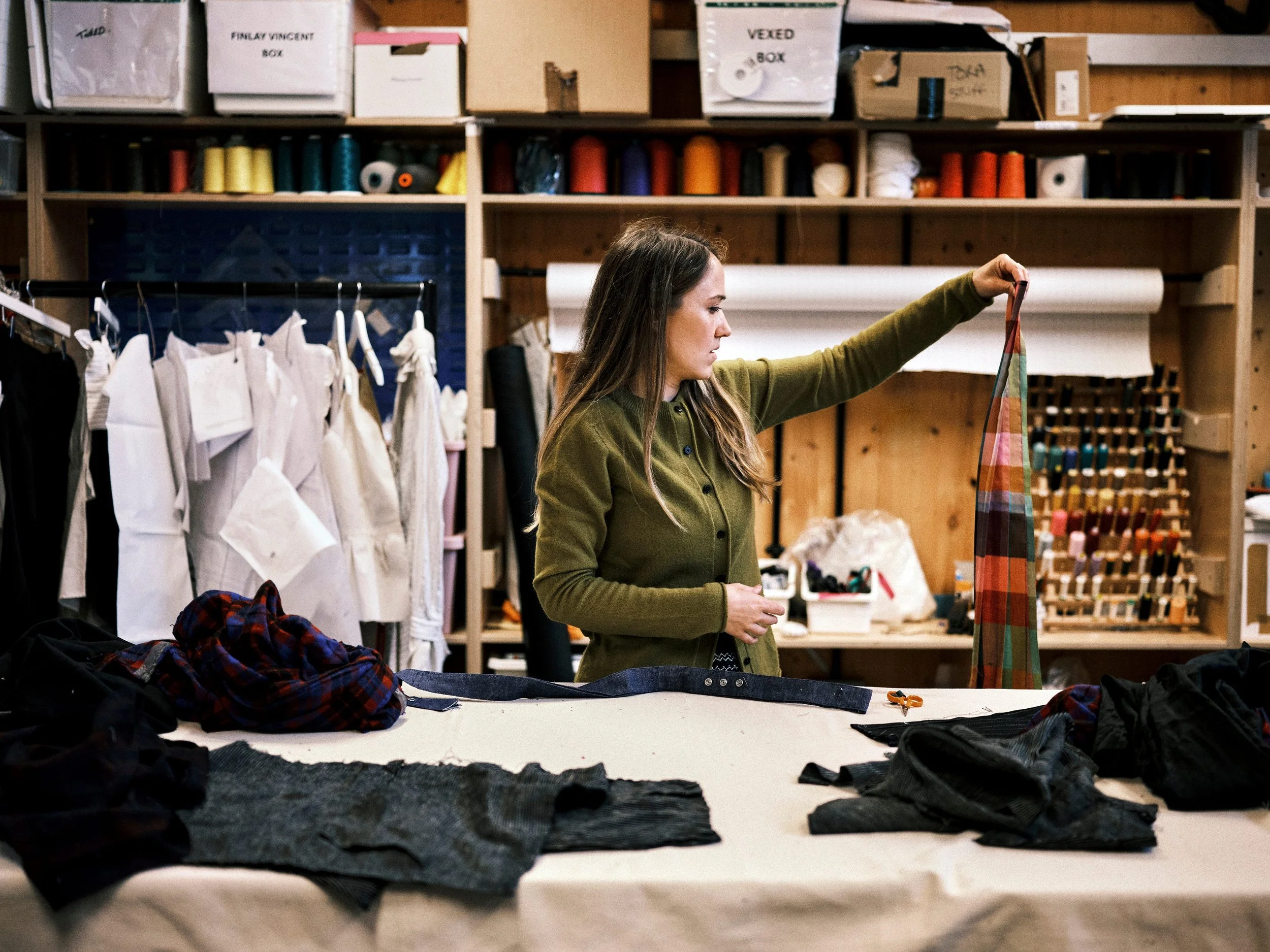
Designer Bethany Williams has built her latest collection from garments that already existed. Her work with TOAST, TOAST Renewed by Bethany Williams, reshapes discarded knitwear, samples, denim and shirts with Manx craftspeople, drawing on her family history and her own recovery.
In this week’s Crafting the Catwalk, our CEO Tamara Cincik talks to Bethany about what slower making looks like in practice. “We shouldn’t have to reach breaking point in order to make meaningful work,” Bethany says, reflecting on the years after her 2019 Queen Elizabeth II Award for British Design.
Working with waste is central to the project. Bethany treats existing materials as a starting point rather than a limitation, arguing that this need not mean compromising on creativity. The discussion also looks at what the industry must change. Bethany points to the need to value handmade, community-led work in how projects are funded, priced and planned, and questions the expectation that fashion must keep producing faster. Her advice to young designers, find collaborators whose values you share, and build a working life you can sustain.
Your relationship with craft and making has evolved since receiving the Queen Elizabeth II Award for British Design in 2019, particularly through your experience of illness and recovery. What has slowing down taught you about your practice?
Receiving the Queen Elizabeth II Award in 2019 was a really special moment, but the years that followed also brought a period of reflection. In 2022, I took time away from fashion to focus on my health and recovery. Spending time on the Isle of Man, reconnecting with nature and being close to my family helped me find my way back to making in a different way.
I started painting and drawing again, and rediscovered the pleasure of working with my hands without feeling that everything had to lead somewhere. I think I had become so accustomed to working at a particular pace that I’d lost touch with some of the curiosity that originally brought me to fashion. Slowing down gave me the space to reconnect with that.
It also changed my relationship with craft. I became more interested in the process itself. In touching materials, draping fabric, experimenting and allowing things to develop naturally. I no longer feel that every idea needs to be pushed towards a finished outcome immediately. There’s value in taking your time, and in allowing yourself to be led by what you discover along the way.
I’ve come to feel strongly that we shouldn’t have to reach breaking point in order to make meaningful work. Rest can be an important part of creativity, rather than something that happens only when we can no longer continue. This project felt like an opportunity to put that understanding into practice and to approach making with more care, openness and patience.
Photography by Aloha Bonser Shaw. @alohabshaw
Your work has long involved collaborations with communities and craftspeople, from San Patrignano and the Magpie Project to women in prison. How did working with John Dog Callister and other makers on The Light We Carry influence the techniques and ideas within the collection?
Collaboration has always been an important part of my practice. I’m interested in the knowledge people hold, the skills they’ve developed over time, and what can happen when different ways of working come together. Often, the most interesting outcomes emerge when you make space for someone else’s expertise rather than trying to control every part of the process yourself.
For The Renewed by Collection, working with Manx craftspeople felt particularly meaningful because the Isle of Man is such a personal place for me. It holds so much of my family history, and its folklore, landscape and traditions have shaped the collection from the beginning.
John Dog Callister’s willow weaving was a beautiful example of how a traditional craft could help bring a new idea to life. The Bumbee bag was inspired by traditional woven willow bumbee cages, which were used as rattles for children. I reimagined that form through the idea of a Hop-tu-Naa lantern. Something that could hold light and speak to the return of light through winter. The word bumbee means bumblebee in Manx Gaelic, so the piece also carries a connection to the language and culture of the island.
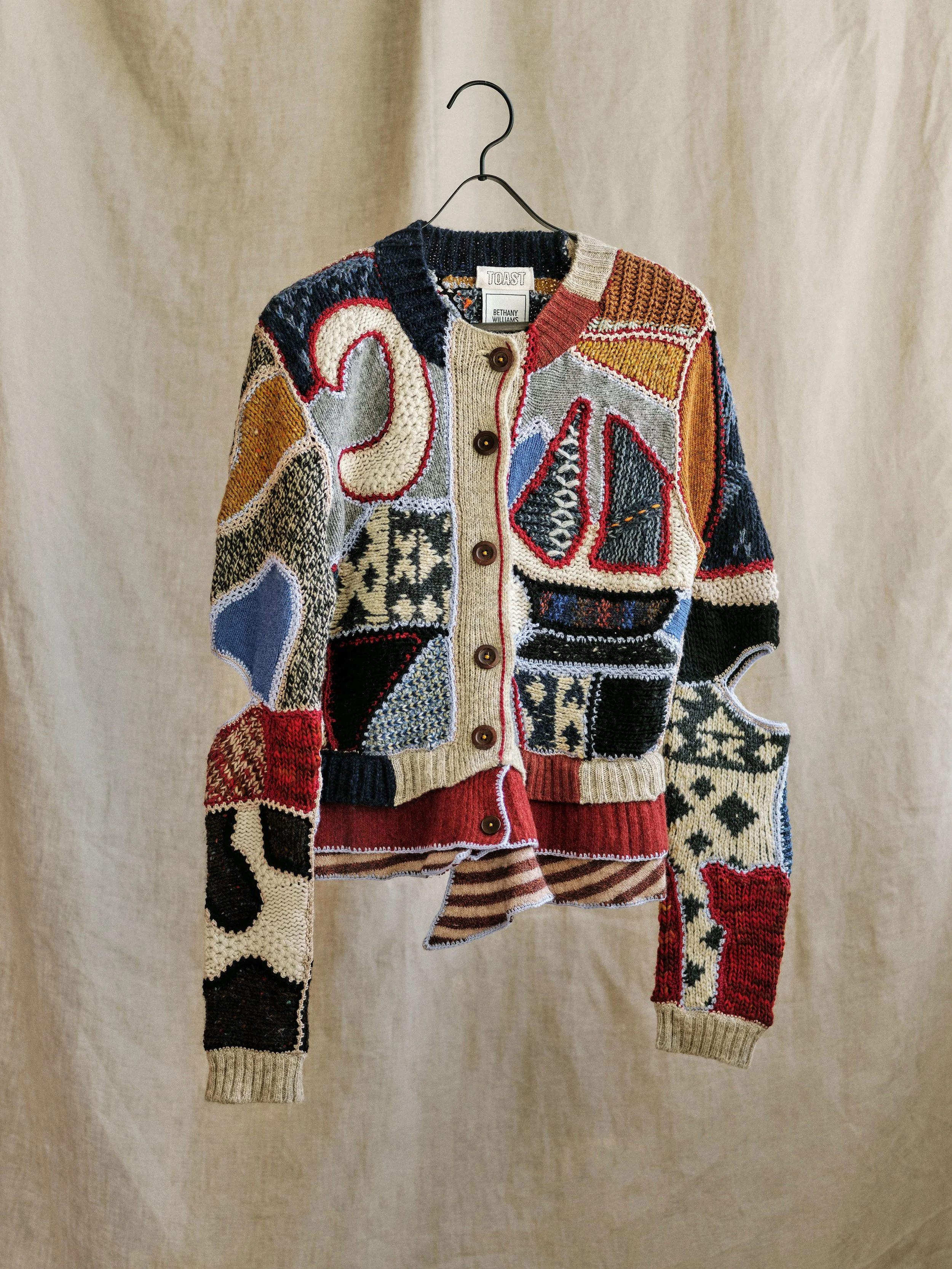
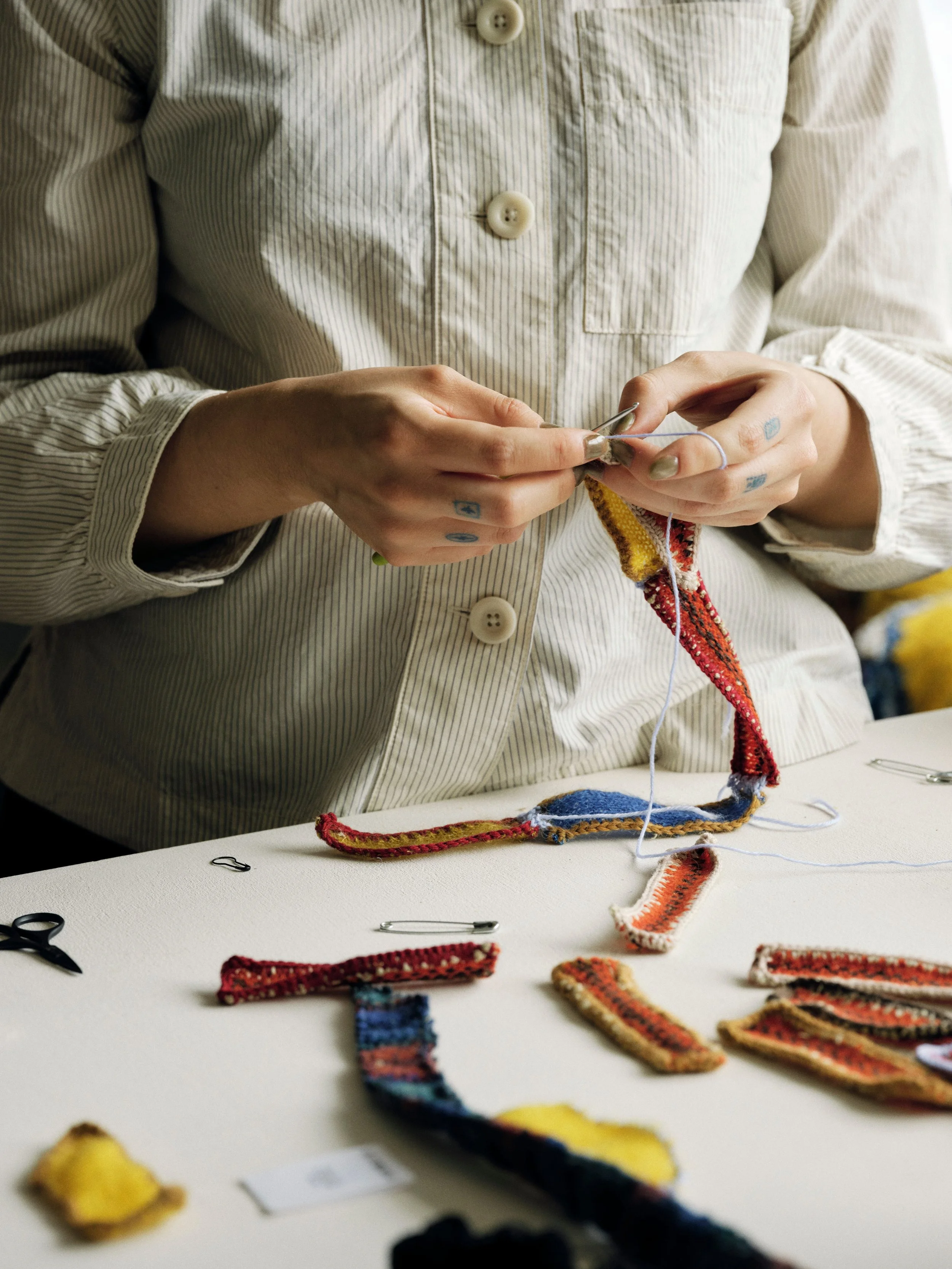
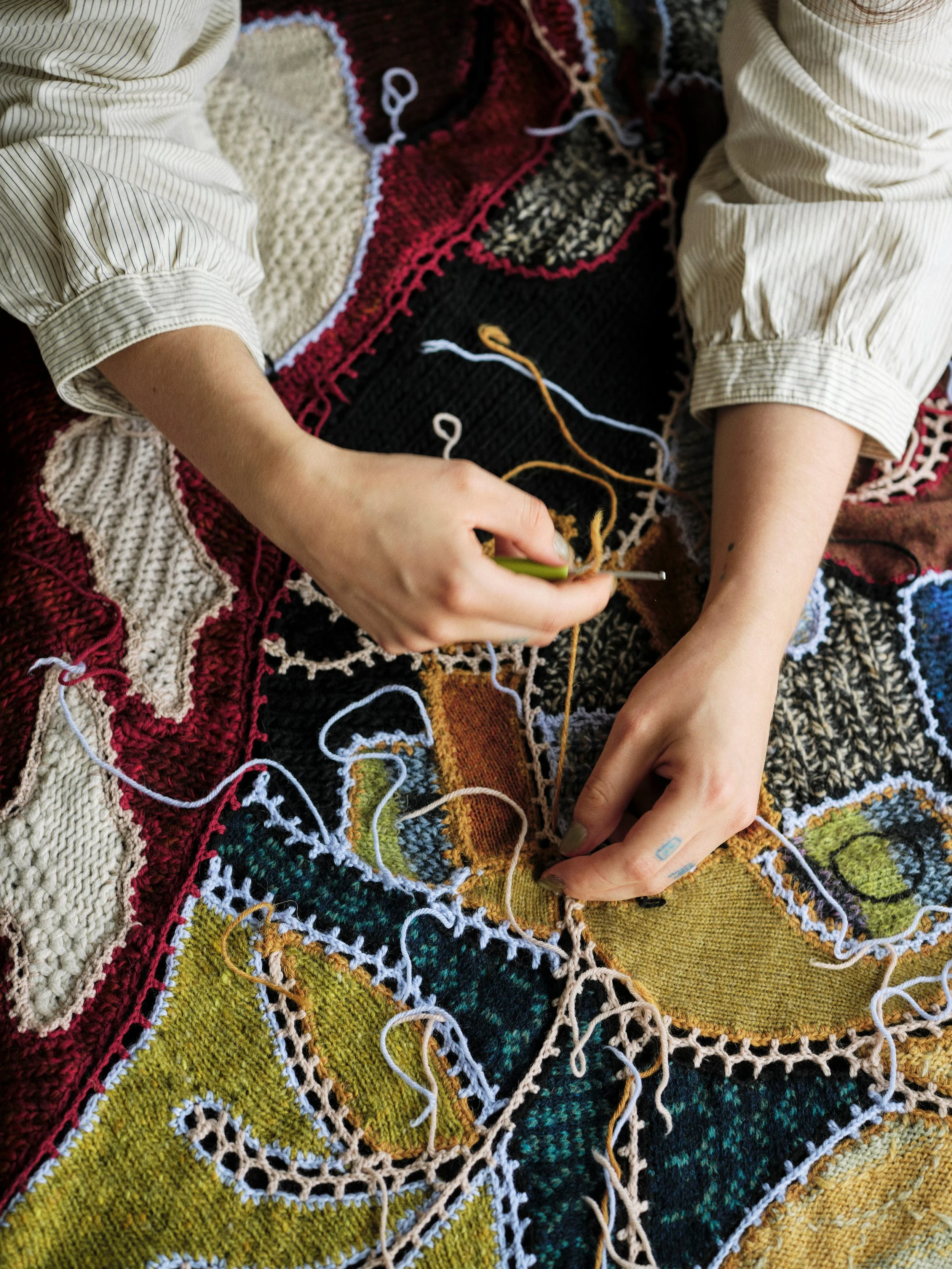
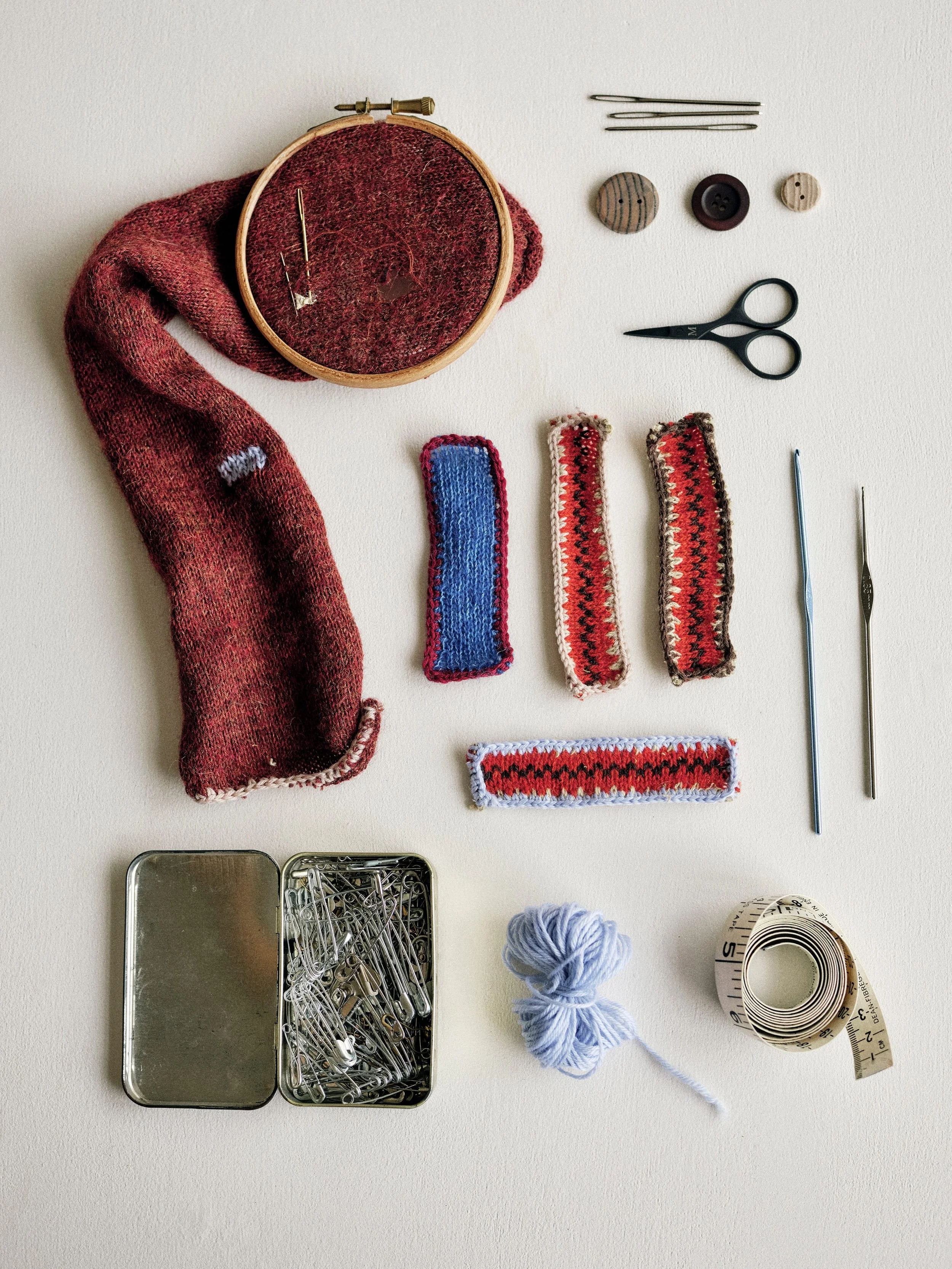
I also worked with Alice Morell Evans, who translated my original paintings into crochet patchwork using waste knitwear and sample swatches, and Holly at Orto Print Studio, who explored screen printing and overdying. Making for Change supported the construction of the garments. Each collaboration brought a different skill and perspective to the work.
What I value about these relationships is that they allow the work to become more than a single person’s idea. The techniques, materials and knowledge of the people involved become part of the story of the finished piece.
Photography by Aloha Bonser Shaw. @alohabshaw
TOAST has a strong tradition of storytelling through craft, and this collection draws on your paintings, Manx childhood, family archive and experience of recovery. How did you translate such personal material into textiles and garments?
Research was an important starting point. I spent time looking at family photographs, memories, Manx folklore, the landscape and the stories passed down through generations. I was interested in lineage, in the ways we carry the people who came before us, and in how love and guidance can remain with us even as they change form.
I began by writing what I call a body text. For me, this is a way of bringing together the thoughts, feelings, research and experiences that sit behind a project before moving into the visual or physical work. It helps me understand the emotional thread connecting the different ideas. For this collection, that thread was about recovery, belonging, family, the Isle of Man and the possibility of beginning again.
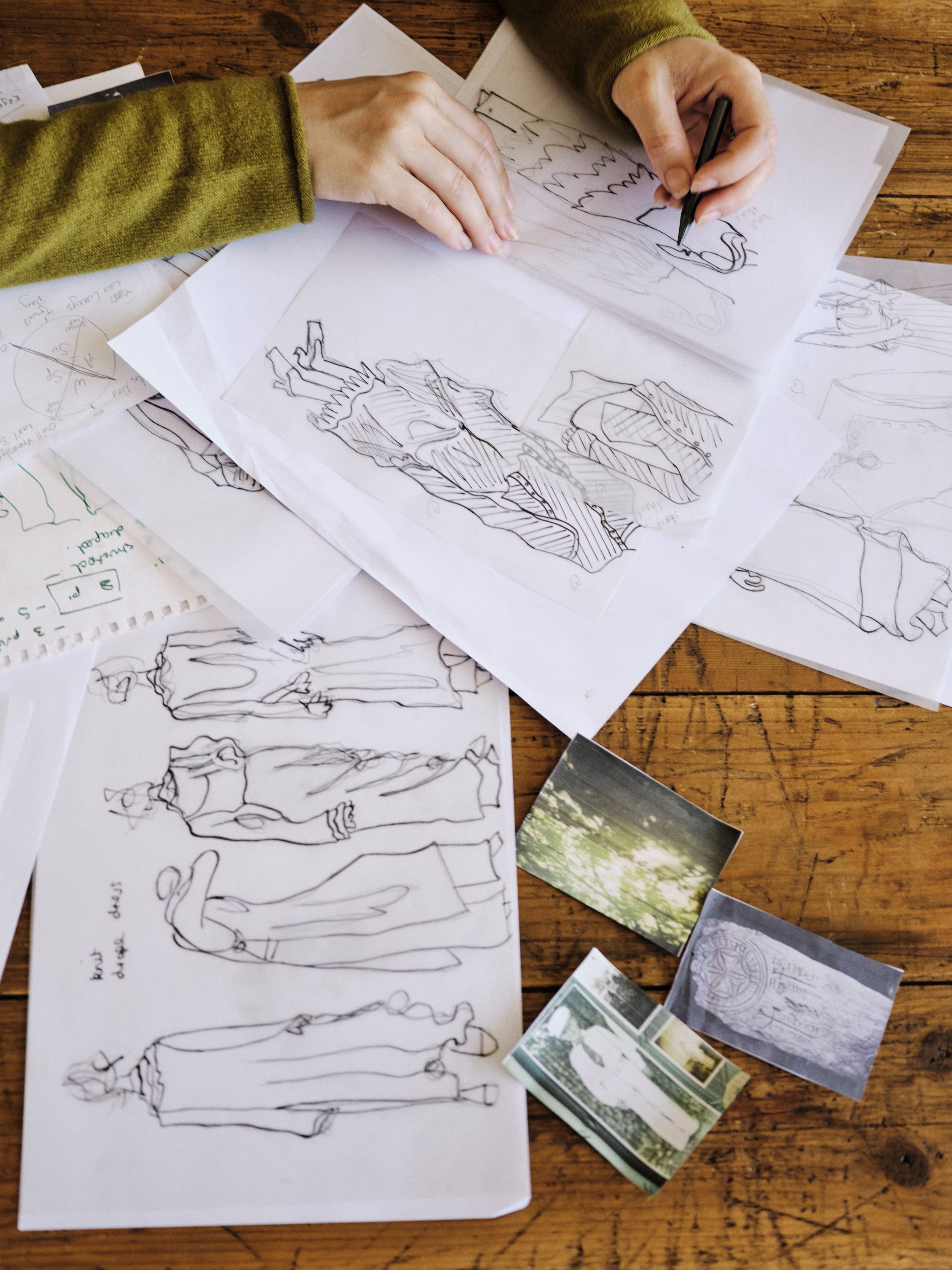
From the writing, I moved into painting and drawing. These works became a way of exploring the ideas through images, before translating them into textiles and garments. I then began working directly with the existing pieces, draping and reshaping them, and seeing how the materials might respond.
The artwork Lineage, for example, depicts my mum, my great-grandmother and me leaning on one another’s shoulders. It reflects the feeling that we are supported by the generations before us, and that this connection continues even when people are no longer physically beside us. Open Heart shows a woman beside a standing stone, surrounded by ancient stones and winter bracken. It speaks to the courage involved in opening yourself up again after a difficult period, and in beginning something without knowing exactly where it will lead.
I wanted the garments to carry some of that feeling. Working with existing pieces meant that they already held traces of another life. Previous stitches, signs of wear, familiar shapes and materials. Rather than removing every mark of their past, I wanted to work with those histories. Through patchwork, print, overdyeing, draping and changes of silhouette, the garments became something new while still holding on to something of what they had been.
There’s a slightly ghostly or off-kilter quality to some of the pieces, with raw edges and asymmetrical shapes. I think that reflects the collection’s interest in memory: something can be familiar, but it is never entirely fixed. It changes as we do.
Photography by Aloha Bonser Shaw. @alohabshaw
The TOAST Renewed by Bethany Williams collection, made using existing garments and materials from the TOAST Circle programme, includes individual pieces including The Light We Carry. How can a slower, handmade, community-led approach be commercially viable, and what changes would help the wider industry work this way?
I was really interested in the opportunity to work with TOAST because the project began with materials that already existed. I love having waste as a creative parameter. It gives you a different starting point: rather than deciding what to produce and then sourcing everything to fit that idea, you begin by looking at what is already available and asking what it might become.
The sourcing and collecting of the garments through TOAST Circle was an important part of that process. I was interested in the range of pieces coming together. Old knitwear, samples, scarves, denim, shirts and other garments. In the different possibilities each one offered. Their previous lives became part of the creative process.
The TOAST team was amazing throughout. Laura, TOAST’s Creative Director, was incredibly supportive, and the Circle team made it possible to explore the materials with care and curiosity. I felt there was a shared understanding that the process mattered as much as the outcome, and that we should allow ourselves the time to experiment.
I think projects like this show that working with existing materials doesn’t have to mean compromising on creativity. In many ways, the limitations make the work more interesting. Each garment presents its own challenge, and the result is a collection of individual pieces rather than something that can simply be reproduced in exactly the same way.
For this approach to become more viable across the industry, we need to recognise the time, skill and resources involved. Sourcing, sorting, repairing, adapting and making by hand all require labour. If we want to value these processes, that value has to be reflected in the way projects are funded, priced and planned.
I also think we need to question the expectation that fashion must constantly produce something new, faster and in greater quantities. Slowing down is not only about the pace of an individual designer; it requires a wider shift in how we understand value. We need more space for experimentation, longer timelines and better support for the people doing the work. There is no single solution, but projects like The Light We Carry offer a way to explore what becomes possible when we start with what we already have and give it the attention it deserves.
Photography by Aloha Bonser Shaw. @alohabshaw
You co-founded the Emergency Designer Network during the pandemic. What did that experience teach you about collective action, and what advice would you give to young designers trying to build more responsible practices today?
The Emergency Designer Network came together during the pandemic, when it became clear that there was an urgent need for personal protective equipment for NHS trusts. I co-founded it with Phoebe English, Holly Fulton and Cozette McCreery. We brought designers and makers together to respond to that need, using our skills and networks to support people on the frontline.
It was a powerful experience because it showed what can happen when people share knowledge, resources and responsibility. Everyone was working in difficult circumstances, but there was a real sense of purpose. It reminded me that design doesn’t have to happen in isolation, and that our skills can be useful in ways that extend beyond the conventional fashion system.
Fashion Roundtable’s support was invaluable, particularly in helping connect the work with the government. That experience reinforced how important it is to have people and organisations who can help bridge the gap between creative communities and the wider systems that shape our lives.
For young designers, I would say that you don’t have to do everything alone, and you don’t have to have every answer from the beginning. Find people whose values you share, learn from one another, and build relationships that allow you to work in ways that feel meaningful to you. Collaboration can make things possible that would be much harder to achieve individually.
I’d also encourage emerging designers to protect their curiosity and to think carefully about the kind of working life they want to build. It can be easy to feel that you need to move quickly, say yes to everything and constantly prove yourself. But creativity needs time, and a responsible practice should also be one that allows the people within it to be well.
We need an industry that supports designers not just to start something, but to sustain it. With fairer structures, access to education and resources, and a greater willingness to value care, repair and collaboration. For me, slowing down fashion is about more than making fewer things. It’s about creating the conditions for people to make thoughtful work, to learn from one another and to keep going without having to sacrifice their wellbeing.
Photography by Aloha Bonser Shaw. @alohabshaw
“Find people whose values you share, learn from one another, and build relationships that allow you to work in ways that feel meaningful to you. Collaboration can make things possible that would be much harder to achieve individually.”