
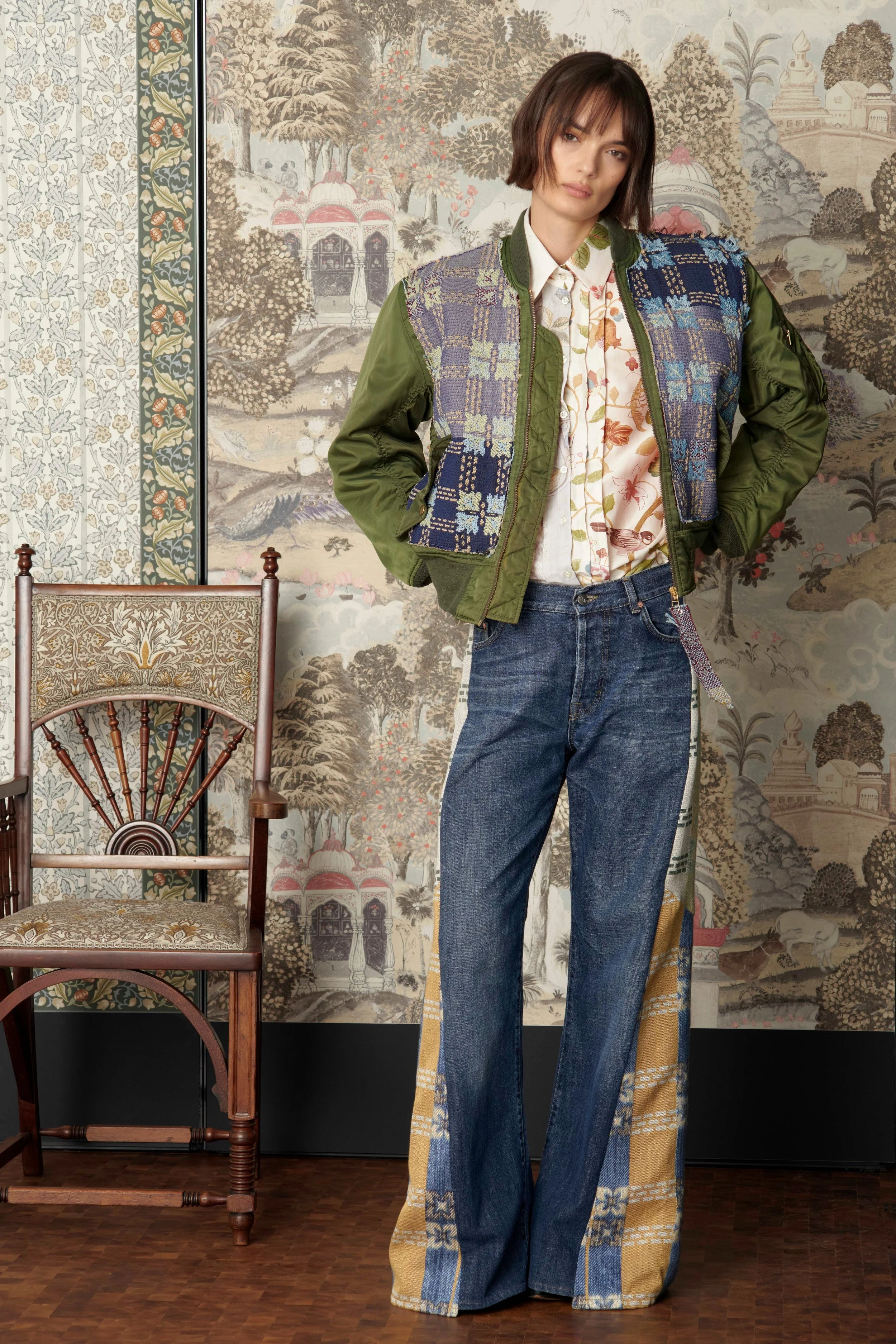
Credit: E.L.V. DENIM, Photographer Benedikt Frank
Sanderson has been making fabric and wallpaper since 1860, and its archive holds printing blocks dating back to the 16th century. In this week’s Crafting the Catwalk, Tamara Cincik sits down with E.L.V. DENIM founder Anna Foster. Foster explains how the collaboration started at Sanderson’s Chiswick studios, how her team sorted through surplus fabric and archive pieces, and why every garment is hand-cut within three miles of her East London studio. She also makes the case for heritage houses to treat their archives as a collection in their own right.
Sanderson is one of my favourite interior brands, making fabrics and wallpapers since 1860. E.L.V. DENIM is a newer company using denim and fabrics to create cherished pieces from secondhand textiles which might otherwise have ended up in landfill. I love this collaboration and wonder how did the conversation begin, and what did each of you learn from the other?
It began with Walpole. I was named one of Walpole’s Brands of Tomorrow for 2025, and as part of the programme I was paired with a mentor, Mauricio Soldujin, Global Business Director of Sanderson Design Group. Through that relationship, the possibility of working together naturally came up, and by January this year the project was in the pipeline.
What brought us together was a shared respect for material. Sanderson has spent more than 160 years creating beautiful fabrics, and at E.L.V. DENIM our founding ethos is to revalue the material in what already exists. Just because a piece of fabric is no longer wanted in its original form, it doesn’t mean the material has lost its value. That held true for Sanderson’s textiles as much as for a vintage jean.
It all started at Voysey House, Sanderson’s headquarters in Chiswick and home to their heritage design studios. My team and I spent time sorting through their surplus fabric, the offcuts and pieces from past collections that were considered unusable, and picking out the ones that could be given a new life.
From Sanderson we learnt about their archive, print heritage and how their fabrics are woven; all essential information for our process of giving them a different purpose in this project, namely to be worn as clothing rather than becoming home furnishings.
Their archive holds printing blocks dating back to the 16th century, which I was lucky enough to see (but not touch!). Therefore, I hope what we brought to them is a different way of looking at their surplus, and proof that circular design doesn’t have to stay a concept; it can be something you really want to wear.
“Just because a piece of fabric is no longer wanted in its original form, it doesn’t mean the material has lost its value. That held true for Sanderson’s textiles as much as for a vintage jean.”
You’ve taken even the smallest leftovers of bed linen and worked them with your denim crochet techniques. Which craft skills did this collaboration ask of your makers, and by using Sanderson’s fabrics and archive, what learnings did your team gain?
The process is exactly the same as for E.L.V. DENIM. As always for us, the fabric comes first and the designs come second. We categorised every Sanderson textile and matched each one to the garment it would become, then paired it by hand with 100% upcycled post-consumer denim, so no two pieces are the same. We consider and reconsider every piece before a single cut, so we can extract as much material as possible. Our goal is to turn every piece of material in our possession into something meaningful, and that is why even the smallest leftovers mattered.
Crochet is how we make sure nothing is left behind. When a piece of fabric is too small to cut a panel from, we cut it into strips and crochet it. We developed the technique with hotel bed linen, and it went all the way to a full-length crocheted bed linen gown at our London Fashion Week presentation.
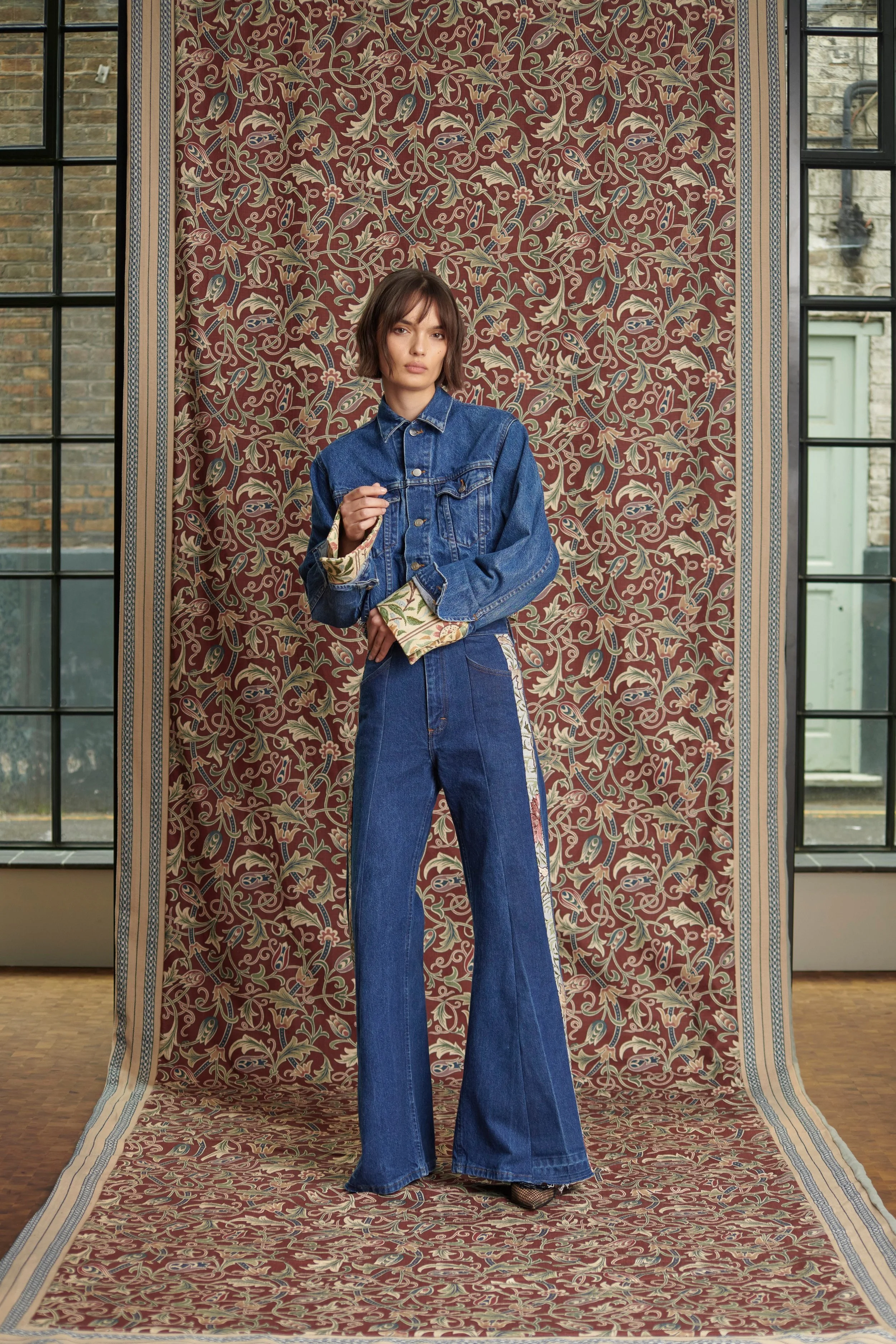
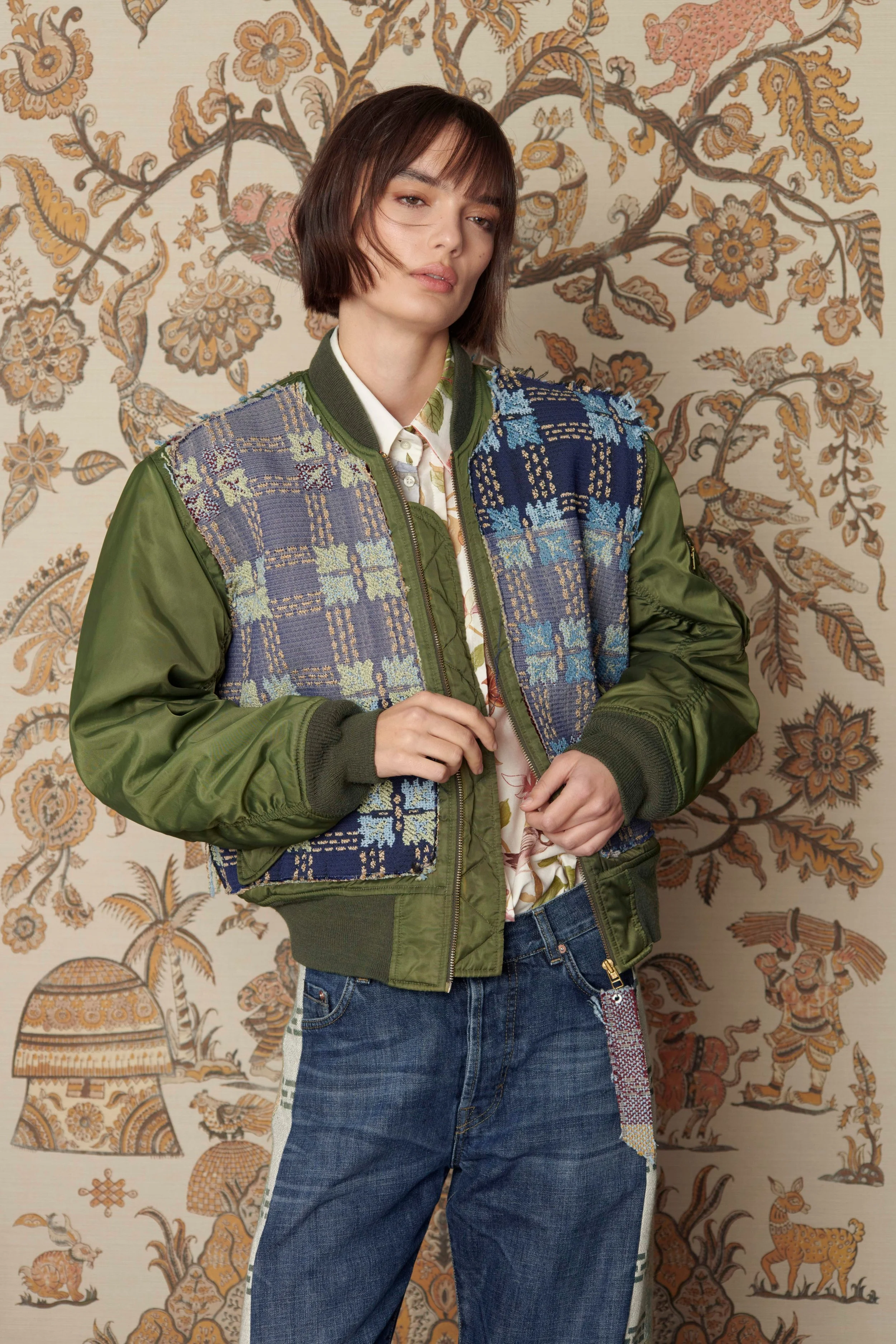
With Sanderson, it asked our makers for real precision: hand cutting panels so the print sits exactly where we want it, like the Sanderson fabric running down the seam of the Indre or the panels on the Rio Bomber, and then working the leftovers in alongside the denim.
Working with a different textile always teaches us something. Every fabric behaves differently, and our reconstruction must respect the properties of the material. Interior fabrics are woven to be hung or upholstered, not worn, so understanding their weight and structure was essential to making them move as clothing. Each transformation, and the knowledge we gain from it, often inspires the next garment. The processes are what is really valuable, and every new textile extends what we can do. We started with denim, grew into shirting and corduroy, upcycled curtains and linen from luxury hotels, and now Sanderson’s fabrics.
Credit: E.L.V. DENIM, photographer Benedikt Frank
Which is your favourite item in the collection and could you explain why?
That is the hardest question, as I am so invested in every single piece! But if I had to choose, it would be the INDRE. She is an adaptation of our best-selling ODETTE jean and she is elegance personified (named after a dear friend and collaborator Indre Rockefeller!). She is fitted from the high waist and finished with an exaggerated flare, with the beautiful Sanderson fabric running down the seam. When I wear her, I feel so tall, not to mention elegant!
We shot our lookbook at Voysey House surrounded by the very patterns woven through the collection, so these images really tell the whole story of the collaboration.
“Crochet is how we make sure nothing is left behind. When a piece of fabric is too small to cut a panel from, we cut it into strips and crochet it. We developed the technique with hotel bed linen, and it went all the way to a full-length crocheted bed linen gown at our London Fashion Week presentation.”
Credit: E.L.V. DENIM, photographer Benedikt Frank
Your production sits within three miles of your East London studio. I love that your approach is a truly localised supply chain. Could you tell me a little bit more about how that works: how did you find your production so close to home, and how does that impact your working life and shape your sustainability agenda?
East London is the heart of E.L.V. DENIM. It’s where I live, where my family is, and where the brand was born. It was a clear-cut decision to produce only here. The area has a long history of manufacturing and skilled craftsmanship, and as a London-based brand I believe I have a duty to support the local community and businesses, to make sure that heritage keeps growing.
Day to day, it means I can be deeply involved in every stage of the process, which suits my perfectionist nature! Each piece is manufactured one at a time, with the atelier approaching each garment as if for the first time, hand cutting and reconstructing with care. Even our washing is local: we have used the same laundrette for more than eight years. We are proud to work with small ateliers where every employee is valued and rewarded accordingly.
For our sustainability agenda, it naturally means the lowest possible carbon footprint. It also makes us transparent. The key to knowing whether a brand truly has sustainability at its heart is how simple it is to see where its materials are sourced, who makes the clothes and where they are made. We are proud of all three.
You were the first fully upcycled brand at London Fashion Week. What should this collaboration show heritage houses about their surplus and archives, and what would you ask the government or industry to change so this becomes normal practice rather than an exception?
When I started E.L.V. DENIM, countless people told me an upcycling business model would never work. In February 2025 we became the first fully upcycled brand on the official London Fashion Week schedule, which showed that upcycling is no longer niche; it’s a blueprint for the future. Our collaboration with THE OUTNET reworked past-season stock into 1,000 units across 50 styles, and Sanderson shows the same approach works for interiors. Surplus and archive textiles aren’t a problem to be stored or destroyed. They are a creative, conscious and revenue-generating opportunity. If a material already exists, no matter what industry it comes from, why create a new one?
I would love every heritage house to see upcycling as an exclusive collection that sits alongside its main collections. Its creation cost the environment so much in the first place, so this material deserves a second life.
From government and industry, the first ask is legislation, and holding people accountable to it. We work really hard to set new standards, and that is undermined when brands use words like ‘deadstock’ or ‘rework’ to suggest they are sustainable. We created a glossary of upcycling terms with Vogue Business as a starting point, and I hope the Green Claims Directive will separate those doing good from those using buzzwords.
I would also change ‘Made in the UK’ labelling, so it can’t be used on a garment made abroad with the final button sewn on here. And support in the UK is still fragmented: funding, policy and infrastructure need to align to back local manufacturing and circular design.
Above all, transparency must be at the heart of it. It should be simple to understand where materials are sourced, who makes the clothes and where they are made. We can’t all be 100% perfect, but it’s better for everyone to be 1% better than for one person to be 100% perfect. Collectively, we can be the change.
“Surplus and archive textiles aren’t a problem to be stored or destroyed. They are a creative, conscious and revenue-generating opportunity. If a material already exists, no matter what industry it comes from, why create a new one?”