
Tamara Cincik in conversation with Clare Hunter at The Fife Arms Festival of Fashion
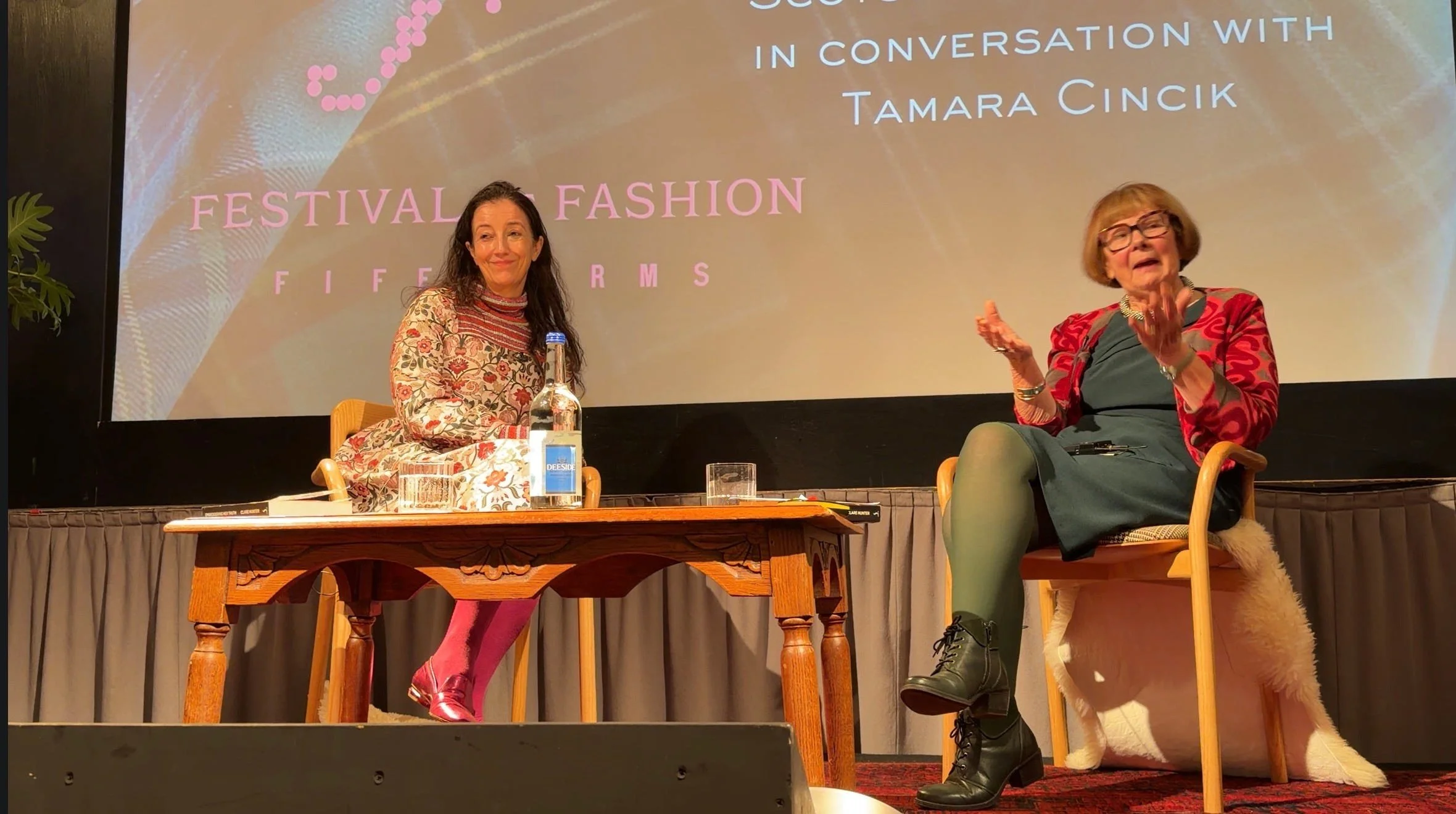
Tamara Cincik in conversation with Clare Hunter at the Fife Arms Festival of Fashion. Image credit: Nine.16.1
Just back from The Fife Arm’s Festival of Fashion, I wanted to tell you all about what a wonderful and heart warming weekend it was. The hills at sunset as we left shone the most beautiful bronze, while my daily morning run took in views of extraordinary misty beauty. For the annual Festival of Fashion, the Fife Arms, that glorious, maximalist house of art and good design, opens its doors to designers, makers, writers and curators for a weekend inspired by two remarkable women, Harper’s Bazaar editor Frances Farquharson and her dear friend Elsa Schiaparelli.
It was a weekend of rare generosity. On Friday night, we enjoyed a Michelin starred dinner, while a bagpipe player marched in front of the tartan clad Duff Highlanders. Talks were held in the Victorian village hall, while my bedroom looked out over the Cairngorms, replete with a William Morris inspired bathroom and a Tudor rose four-poster, it was, quite simply, heaven. That it fell on my birthday weekend was a gift I hadn’t expected. My heartfelt thanks go to Amanda, Alice, Lily and the whole Fife Arms and Artfarm team, who made my feel so special.
Talks included Christopher and Tammy Kane speaking to Kirsty Wark about their new roles at Mulberry, author and former Harper’s Editor Justine Picardie on Chanel, senior curator at the V&A Oriole Cullen on the Burberry trench, designer Nicholas Daley and his mother Maureen running a knit and natter session, make up artist Val Garland on the catwalk show, and the history of the Highland tartan with the village hall filled with burly men in flamboyant tartan regalia. The audiences were as chic as us speakers, in tweeds, knits, home made designs and vintage cherished pieces, it was a real weekend to store as a treasured memory.
In a departure from my usual conversations about policy and trade, I hosted a talk close to my heart about the embroidery of Mary, Queen of Scots, a conversation I felt was rooted in the location and its myths: herstory to counterpoint the history of the highlanders.
On Sunday, in Braemar Village Hall, author Clare Hunter and I discussed The Power of Textiles and Mary, Queen of Scots. Clare’s book Embroidering Her Truth: Mary, Queen of Scots and the Language of Power looks at Mary’s life through the textiles that surrounded her, and it is one of the most quietly radical books about history told through the context of textiles that I have read.
We tend to remember Mary as a tragic figure: the abdication, the long English captivity, the tragic execution dressed in martyr’s red silk at Fotheringhay, while her dog died of a broken heart. Clare asks us to look at the intentionality of her creative output instead. During almost two decades of imprisonment: 2 years in Scotland, followed by 17 in England, Mary embroidered constantly. This was not a genteel pursuit, it was a visual record of her mental state, her thoughts on others, and the conversations she was unable to have with her allies and enemies. In captivity, Mary stitched with strong intent, she sent a hand embroidered cushion to Thomas Howard, Duke of Norfolk, the man she hoped to marry. It showed a hand descending from heaven to prune a vine, beneath the motto Virescit Vulnere Virtus, which translates as “virtue grows strong by wounding.” When the English advisors, led by Cecil, Queen Elizabeth 1’s right hand man (think John Healey/Ed Miliband/Wes Streeting all rolled into one person to Andy Burnham), decided to have Norfolk executed, the cushion was used as evidence against him and helped send him to his death.
With serial oligarch’s wife, Bess of Hardwick, then her keeper’s wife, she worked on the panels now known as the Oxburgh Hangings, which still hang at Oxburgh Hall in Norfolk. Among them is her emblem of a marigold turning towards the sun, set alongside emblems of courage in adversity. On the foggy morning of her execution, Mary, who was of course a Catholic, wore red. Clare reminds us that it was the Catholic colour of martyrdom. Mary was dressing for how history would remember her.
In June 2024, Maria Grazia Chiuri took Dior’s Cruise 2025 collection to the gardens of Drummond Castle in Perthshire, and Clare’s book was one of her key references. Clare herself described Mary’s embroidery as a form of rebellion and communication. A global luxury house looked at a sixteenth-century prisoner’s needlework and found a modern language of female resilience.
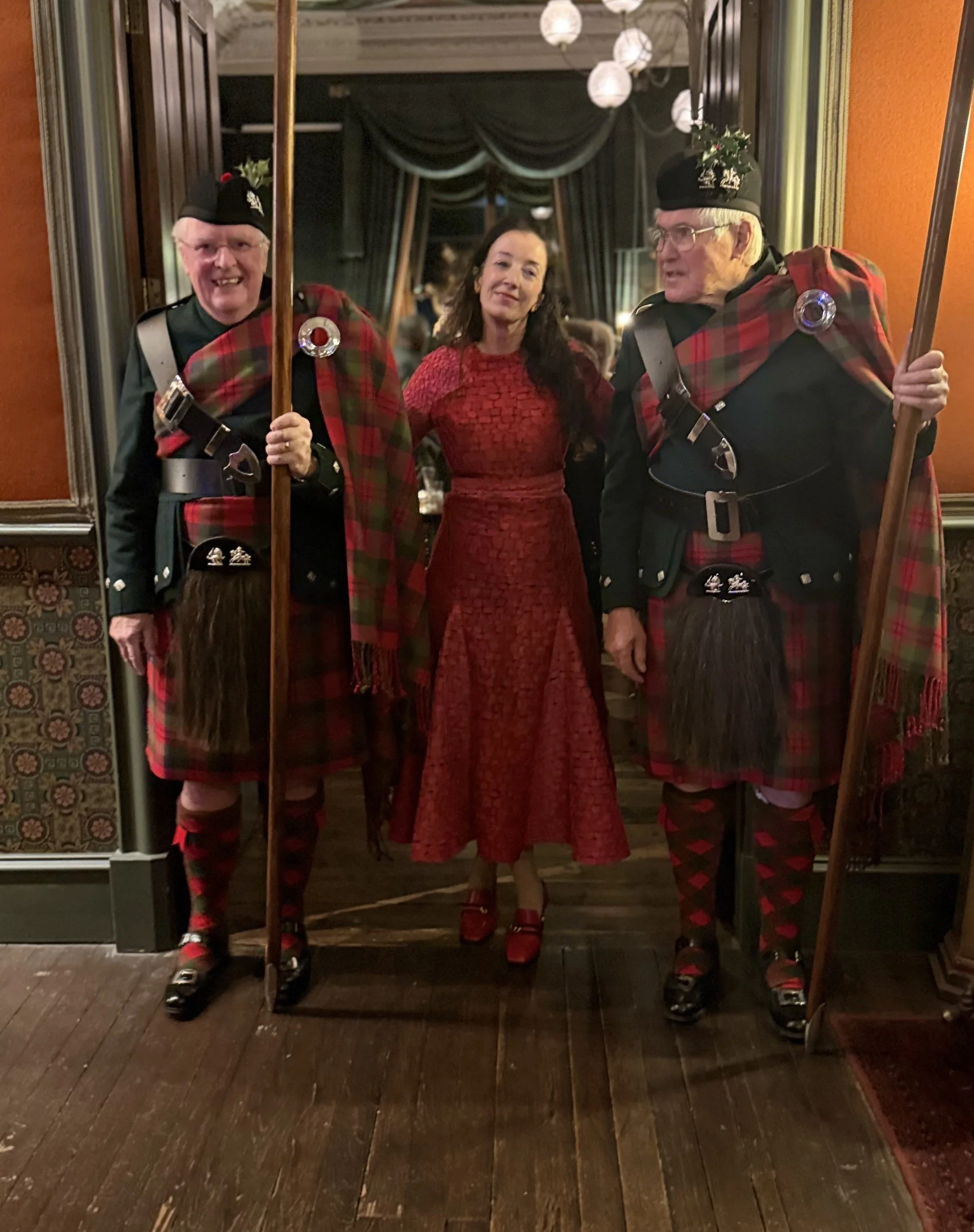
Tamara Cincik, Image credit: Nine.16.1
Sewing, embroidery, weaving and knitting have long been coded as women’s work, and with that label has come a familiar habit of dismissal and erasure. These skills are called hobbies, crafts and heritage, put in what I call the “folky lane,” as though there is something less than about them, but rarely industry. Yet Scotland’s mills, the Highlands’ makers and Britain’s wider textile, fashion and design economy are a genuine national asset of key cultural importance. They show the quality, provenance and sustainability that the global market admires, and place provenance and placemaking at the centre of a national opportunity to revitalise communities and skills.
That is why, with The King’s Foundation, I founded The Great British Wool Revival in 2024 to help rebuild the UK’s fibre economy, from fleece to finished garment. This weekend, the news that the price is now at £1.66 per kilo and when I started GBWR it was 45p is not lost on me. We have strived hard to build the reputation and the opportunities for British wool, from farm to design. And it’s clearly working.
At Fashion Roundtable we consistently make the case, cross-party and evidence-led, that fashion and textiles deserve a proper place in how this country thinks about industry, skills and place. We bring people together, just as The Festival of Fashion did last weekend. Conversations build community and communities build change, creativity is the thread within all that.
Mary’s motto was “En ma fin est mon commencement:” in my end is my beginning. She stitched her way out of silence and into history. Herstory. British textiles have had more than their share of endings: mills closed, skills lost, a sector too often dismissed and overlooked. The Festival of Fashion reminded me of the power of these skills, Mary was literally making craft artefacts to improve her creative wellbeing and communicate with her allies and her enemies, with a form, embroidery, then considered more enduring than a piece of paper as both a valued item and a communication tool, as powerful now as ever.
“Sewing, embroidery, weaving and knitting have long been coded as women’s work, and with that label has come a familiar habit of dismissal and erasure. These skills are called hobbies, crafts and heritage, put in what I call the “folky lane,” as though there is something less than about them, but rarely industry.”